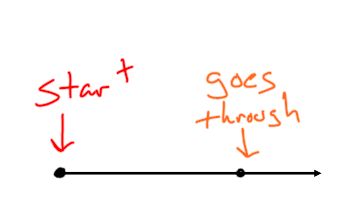
Part of a line that starts at an endpoint* and extends infinitely
in one direction.
Named by its endpoint* and any other point
on the ray, with an arrow on top.
The arrow indicates the direction of the ray, from the
endpoint through any other point
on the ray.
Half of a line that can have any point on a line as its endpoint*.
Two rays on the same line going in opposite directions are
opposite rays.
Two opposites rays can form a line.
*NOTE: In mathematics we call any point that
identifies where the line stops at, as an endpoint. But you are thinking that
a ray is "starting" at that point so why not call it
the "starting point"? We need to remember that a ray
is PART of a line, and a line does not have a starting point or an endpoint,
so the point where the ray starts at is the
endpoint of the line that the ray is on.
YES I KNOW WHAT THIS SOUNDS
LIKE....
Example A
Problem::
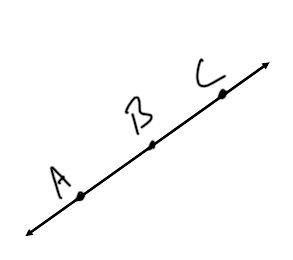
What are the names of the ray(s), if any, that are on
the following line?
Solution:
Since this line has 3-different points on it we will
have 4-different rays that will be on the line.
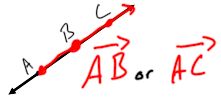
If we use
point A as our starting point we will have the following ray: Since it
goes through 2-other points on the line we can have 2-different names
for the same ray.
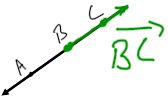
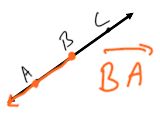
If we use point B as our starting point and we
will have 2-different rays, going in opposite directions:
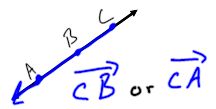
If we use point C as our starting point we will have the following
ray: Since it
goes through 2-other points on the line we can have 2-different names
for the same ray
Watch the video:
Line Segments:
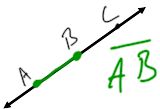
A line segment is:
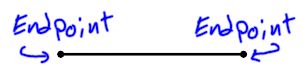
Part of a line consisting of two endpoints and all points
between them.
Named by its two endpoints in either order with a straight
segment drawn over them
A fixed length..
Example B
Problem::
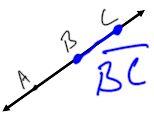
What are the names of the line segment(s),
if any, that are on the following line?
Solution:
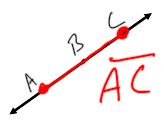
Since this line has 3-different points on it we will
have 3-different line segments that will be on the line as follows:
Watch the video:
Quick Question...
Instructions:
Drag the names that ARE names of the Ray into the "Names" area.
Drag the names that ARE NOT names of the Ray into the
"Not-Names" area
To use the app:
Clickto
begin, click
for full screen mode
Clickto
check your answer
Clickto goto the next problem
Clickto stop the app
Ruler Postulate
The Ruler Postulate states:
The points on a line can be paired in a one-to-one
correspondence with the real numbers such that
Any two given points can have coordinates 0 and 1.
The distance between two points is the absolute value of the
difference of their coordinates.
Distance =
Note: Distance is always positive, so absolute
values is used to calculate distance
We can use The Ruler Postulate to:
Have points on a line segment correspond with the points on a ruler.
Measure the distance between two points
Determine
the length of a segment
Example C
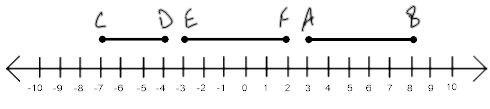
Problem::
What is the distance between AB?
What is the
distance between CD?
What is the distance between EF?
Solution:
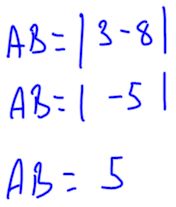
Since A is at 3 and B is at 8 we get the following: So the
distance from A to B is 5.
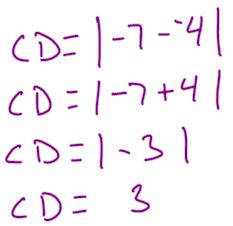
Since C is at -7 and B is at -4 we get
the following: So the
distance from C to D is 3.
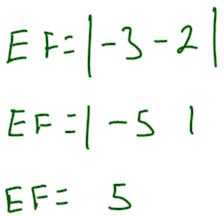
Since E is at -3 and B is at -2 we get
the following: So the
distance from E to F is 5.
Watch the video:
Segment Addition Postulate:
If B is between A and C, then AB + BC = AC.
This also means that AB = AC - BC and BC = AC - AB
Example D
Problem::
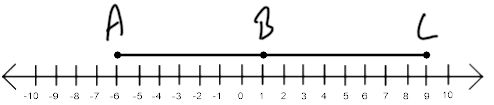
Given the following, how far is it from A to C?
Solution:
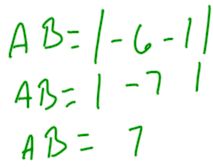
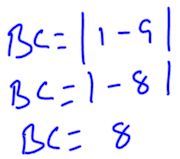
First we need to find the distance for AB. Then we
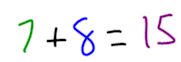
need to find the distance for BC. Now that we
know the distance for AB and BC we can add them together to find the
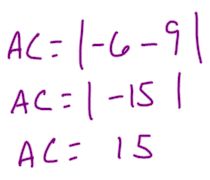
distance of AC. If we check
our work by find the distance from A to C we get: Which
checks.
Watch the video:
Now the last example seems a bit silly to do the way we did it. It
would have been a lot quicker and easier to just find the distance from A to C
to begin with.
However it is not always that simple to find the distance between two points
as we will see in the next example.
Example E
Problem::
Solution:
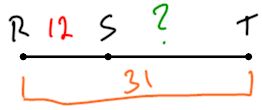
The first thing we need to do is draw out problem we
were given. Make sure that we include all of the information given
to us.
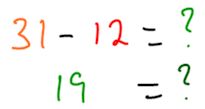
Now that we have the problem drawn out, we can see that the missing
piece, ST is missing and that we will need to subtract RS from RT to
find ST.
Now we know that ST = 19
Watch the video:
Point S lies on
between R and T. RS = 12 and RT = 31. What is the distance for ST?
Quick Question...
Instructions:
Use the "Key-Pad" to enter your answer
To use the app:
Clickto
begin, click
for full screen mode
Clickto
check your answer
Clickto goto the next problem
Clickto stop the app
Midpoint:
The midpoint of a segment is the point that divides the segment into two
equal parts.
So, if M is the midpoint of
,
then AM = MB.
Example F
Problem::
Can you find AC in terms of x, given that B is the
midpoint and AB = 2x - 7?
Solution:
Again, the first thing we need to do is draw out problem we
were given. Make sure that we include all of the information given
to us.
Since we
were given the information that B was a midpoint we know that the
distance between A and B will be the same as from B to C. So we
will write in 2x - 7 as the distance for BC.
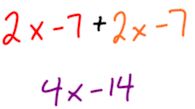
We can now see that
we will need to add AB and BC together as follows: So we now
know the distance of AC in terms of x will be
4x - 14.
Watch the video:
Quick Question...
Instructions:
Use the "Key-Pad" to enter your answer
To use the app:
Clickto
begin, click
for full screen mode
Clickto
check your answer
Clickto goto the next problem
Clickto stop the app
Practice Problems
Remember to show all work required to do the
problem.
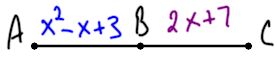
a. Find the distance between the points A and B.
b. Find AC in terms of x.
c. The drive from Newfolden to Lancaster is about 46 miles. Karlstad is approximately the midpoint between Newfolden and Lancaster,
about how far is the midpoint from either city?
Assignment:
Use the following graph to answer 1-3.
1. Find PQ.
2. Find NS.
3. Find MR.
Use the following graph to answer 4-9
4. AB =
5. BD =
6. DE =
7. DC =
8. FD =
9. AF =
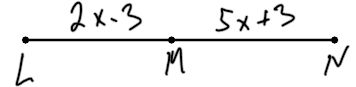
10. Find LN in terms of x.
11. Point G lies on
between
F and H. Find GH if FG = 15 and FH = 34.
12. Point N lies on
between
L and M. Find MN if LN = 2 and LM = 14.
13. Find WY in terms of n.
14. Point D lies
on between
C and F. Find CD if DF = 2 and CF = 45.
15. Find the midpoint of the segment connecting points with coordinates -142
and 53 on a number line.
16. A, B, and C are collinear, AB = 5x - 19, and BC = 3x + 4. Find an
expression for AC if B is between A and C.
17. Points A, B, and C are collinear. Point B is between points A and C. AB =
12, AC = 7x + 5 and BC = 4x - 1. Find x.
18. Points D, E, and F are collinear with E between D and F. DE = 15,
EF = x + 17, and DF = 3x - 10. Find EF and DF
19. Suppose AB = 3x, BC = 2y + 16, AC = 60, and B is the midpoint of
AC. Find the values of x and y.
20. The city is planning to install streetlights and wants five lights along
a walkway of 60 yards. If there is a
light at the beginning and at the end of the walkway
and the lights are evenly spaced, what is the distance between each light?
 to
begin, click
to
begin, click
 for full screen mode
 to
check your answer
to
check your answer to goto the next problem
 to stop the app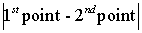
 between R and T. RS = 12 and RT = 31. What is the distance for ST?
 ,
then AM = MB.
,
then AM = MB.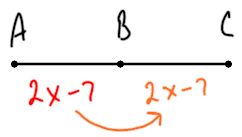



 between
F and H. Find GH if FG = 15 and FH = 34.
between
F and H. Find GH if FG = 15 and FH = 34. between
L and M. Find MN if LN = 2 and LM = 14.
between
L and M. Find MN if LN = 2 and LM = 14.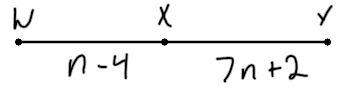
 between
C and F. Find CD if DF = 2 and CF = 45.
between
C and F. Find CD if DF = 2 and CF = 45.