An angle is a figure that can be formed in 2-different ways
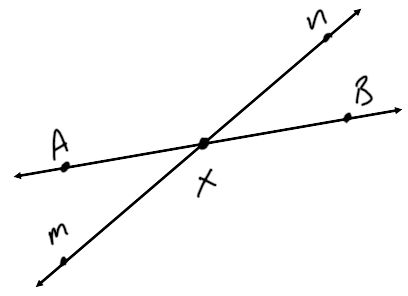
The intersection of two lines will form an angle. The point of
intersection for the lines will be the vertex of the angle.
Two rays with a common endpoint. The common endpoint is the angle’s
vertex. The rays are the sides of the angle.
The exterior of an angle is the set of all points outside
the angle. The interior of an angle is the set of all points
between the sides of an angle. The interior of an angle will be between 0o
and 180o.
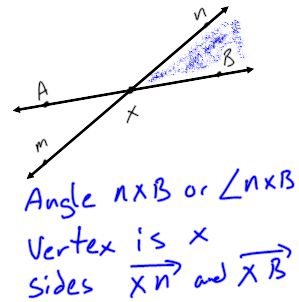
An angle can be named in several different ways: by its vertex,
by a point on each ray and the vertex, or by a number.
Example A
Problem:
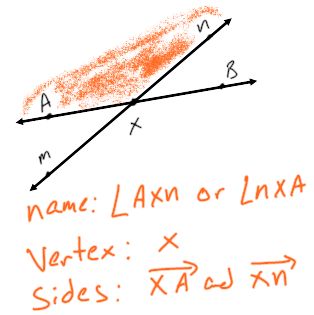
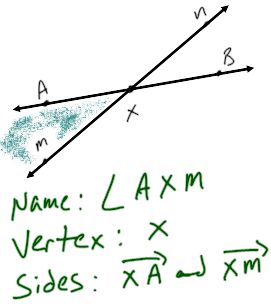
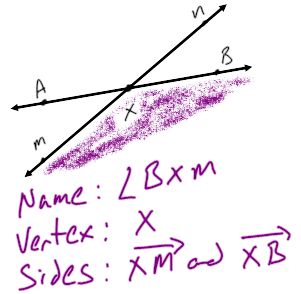
Given the following figure, identify all of the
following: •
Name of the angles
•
Vertex of the angles
•
Sides of the angles
Solution:
We can first identify each angle by it's interior and identify the
name of the angle, vertex of the angle, and sides of the angle.
Watch the video:
Example B
Problem:
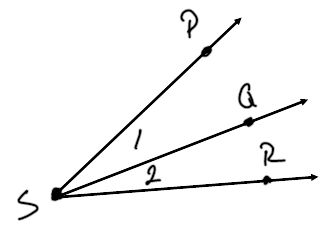
Given the following figure:
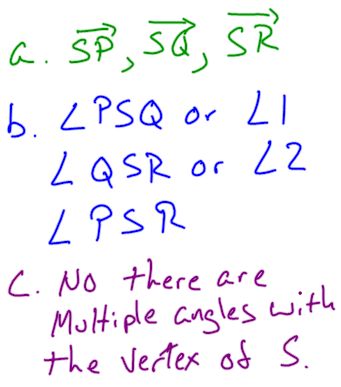
a. Name three rays in the diagram.
b.
Name three angles in the diagram
c.
Could
PSQ
also be referred to as
S?
Solution:
Watch the video:
Quick Question...
Instructions:
Use the "Key-Pad" to enter your answer
To use the app:
Clickto
begin, click
for full screen mode
Clickto
check your answer
Clickto goto the next problem
Clickto stop the app
Protractor Postulate
The points on a semi-circle can be paired in a one-to-one
correspondence with the real numbers such that:
The smallest degree measure is 0o and the largest
degree measure is 180o.
The protractor is always placed as follows to measure the
angle.
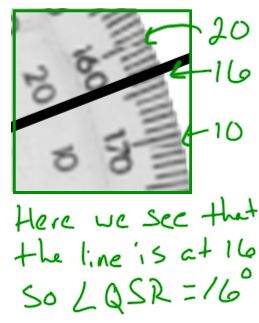
A protractor is a tool used to measure angles. Unlike segments, angles are
measured in degrees. One degree is a unit of angle measure that is equal to
of
a circle.
Now try this...
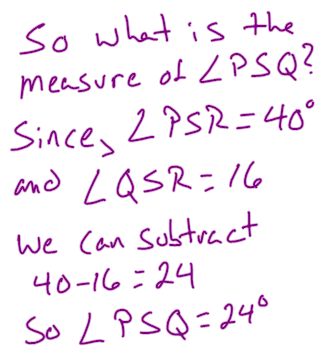
Angle Addition Postulate:
If
AXB
has a common side with
BXC,
,
then
AXC
=
AXB
+
BXC
This also means that
BXC =
AXC
-
AXB
and
AXB =
AXC
-
BXC
Example C
Problem:
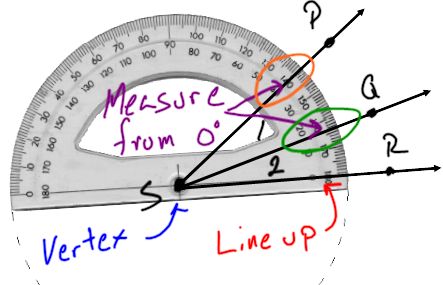
What are the measures of each angle in this figure?
Solution:
Put the protractor on the angle.
Watch the video:
Types of Angles from Intersecting Lines:
When two lines intersect, their intersection will form 2-pairs of angle,
If we look at the rays formed by the intersecting lines we can then identify the
angles and classify them according to their angle measure.
If two lines intersect like this:
,
then you will have these angles:
An acute angle measures greater than 0° and less than 90°.
An obtuse angle measures greater than 90° and less than 180°.
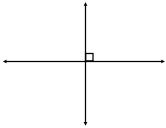
If two lines intersect like this:
" Perpendicular Lines ", then you will only have this angle:
A right angle measures exactly 90°. A box drawn at the vertex of an
angle shows that it is a right angle, as shown in the diagram.
If two lines intersect like this:
" Coinciding Lines ", then you will only have this angle:
A straight angle measures exactly 180°.
Example D
Problem:
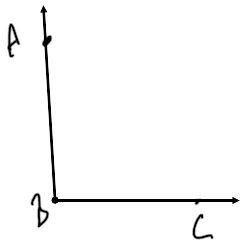
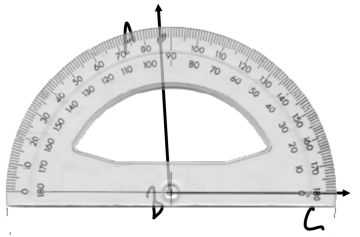
Given the following angle, identify the angle measure
and type of angle.
Solution:
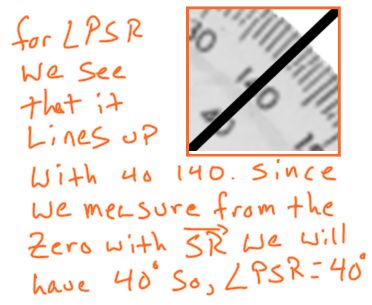
First we need to line up the protractor on the angle.
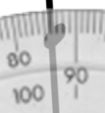
We
now need to look at where the ray intersects the protractor to find its
measure.
It looks like the ray is on 94, remember we always
measure from the line that is on the zero line on the bottom of the
protractor.
So we
have an angle measure of 94°. Since this is a measure that is
between 90° and 180°, we have an obtuse angle..
Watch the video:
Angle Bisectors and Congruence Marks
To bisect a figure is to divide it into two congruent parts. An angle
bisector is a ray that divides an angle into two congruent angles. Congruent
angles have the same measure. They are marked with arc marks.
NOTE: We can never use a protractor to
determine if an angle has been bisected. We can only determine if a angle
is bisected or even congruent by either construction or with algebra.
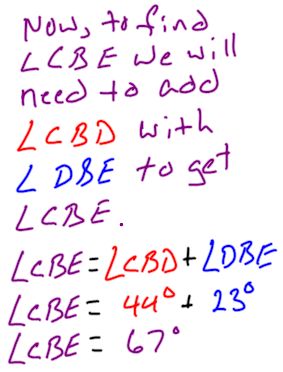
Example E
Problem:
Solution:
Watch the video:
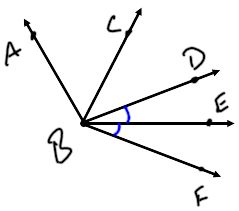
The measure of
ABC
= 44°.
bisects
ABD.
The measure of
EBF
= 23°.
Find the measure of
CBE.
Quick Question...
Instructions:
Use the "Key-Pad" to enter your answer
To use the app:
Clickto
begin, click
for full screen mode
Clickto
check your answer
Clickto goto the next problem
Clickto stop the app
Practice Problems
Measure each angle and complete each statement.
A. The blue has an angle measure of ____________ and is a/an
____________ angle.
B. The red has an angle measure of ____________ and is a/an
____________ angle.
C. If a 174° is angle bisected, what will angle measure be of the
resulting two angles?
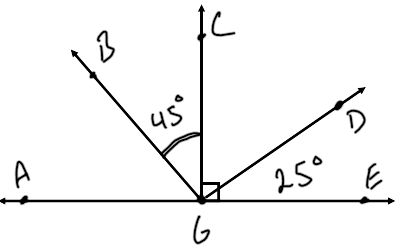
Use the following diagram to classify and find the measure of each
angle.
D. AGC
E.
AGB
F.
CGD
G.
BGD
H.
AGD
Assignment:
For this assignment
Use the Geogebra App below and do all 10 problems.
Take a FULL SCREEN SCREENSHOT and COPY TO CLIPBOARD
Paste the screenshot into the Google Doc for this assignment.
For corrections, reload the Geogebra App and do another 10 problems
DO NOT CLOSE THE TAB FOR THIS PAGE, YOU LOSE ALL WORK AND
NEED TO START OVER AGAIN!
 PSQ
also be referred to as
PSQ
also be referred to as
 to
begin, click
to
begin, click
 for full screen mode
 to
check your answer
to
check your answer to goto the next problem
 to stop the app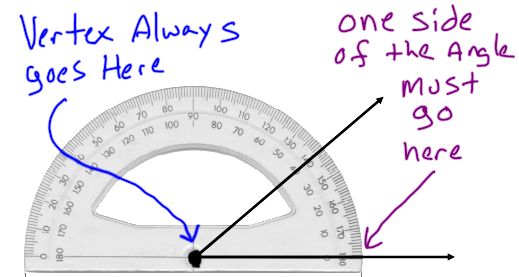
 of
a circle.
of
a circle. ,
then
,
then
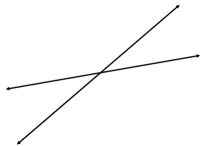 ,
then you will have these angles:
,
then you will have these angles:
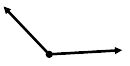
 " Perpendicular Lines ", then you will only have this angle:
 " Coinciding Lines ", then you will only have this angle:
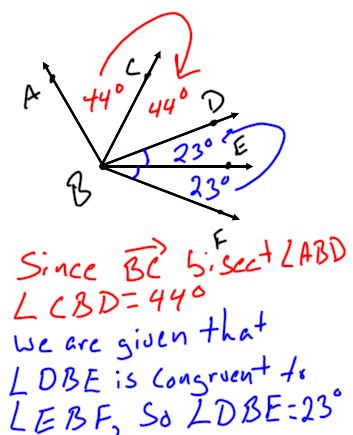
 bisects