Lines and planes are classified by whether or not they intersect and how they
intersect. At this time we are only going to consider what happens when
lines and planes do not intersect.
Planes:
When it comes to planes there are really only two possibilities, either they
intersect or they don't. If two planes do not intersect, then they are
parallel.
Example A
Problem:
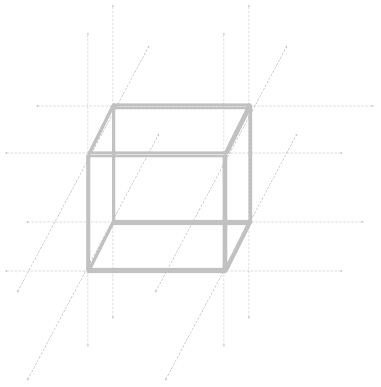
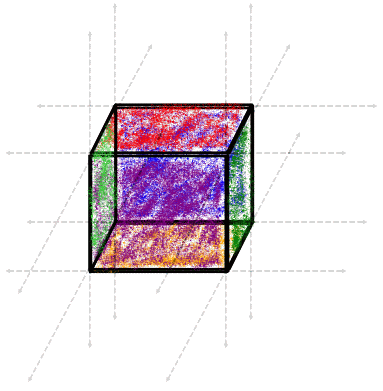
Given the following figure, can you identify all parallel planes?
Solution:
If we think of this figures as a simple box, we would realize that
the opposite sides would be parallel. S we would think of the
sides of the box as planes. so would have:
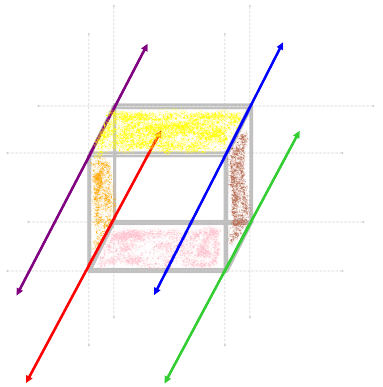
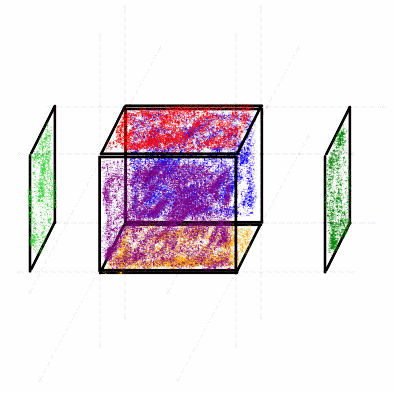
Here we can see the
green sides are on opposite sides of the box and so the these 2-planes
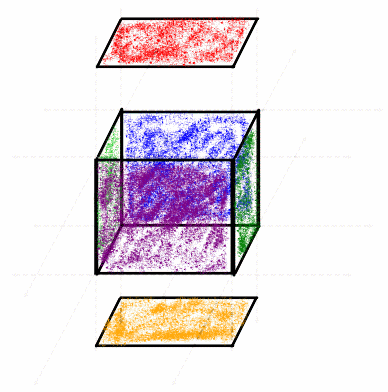
would be parallel. Here we can
see that the red top and the orange bottom are on opposite sides of the
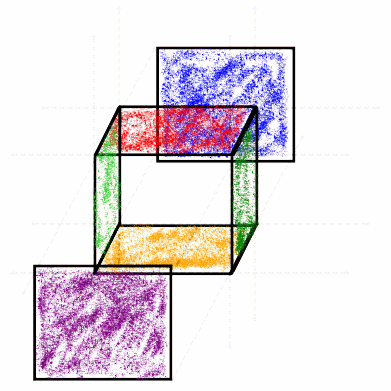
box and so the these 2-planes would be parallel. Here we can
see that the purple front and the blue back are on opposite sides of the
box and so the these 2-planes would be parallel.
Watch the video:
So when it comes to planes they will either intersect ( which will always be
a line ) or they will never intersect ( like the floor and ceiling of a room ).
Quick Question...
Instructions:
Click either "True" or "False"
To use the app:
Clickto
begin, click
for full screen mode
Clickto
check your answer
Clickto goto the next problem
Clickto stop the app
Lines:
There are three possible ways for a pair of lines to be related to each
other..
Coplanar Lines, if two lines are on the same plane and do not intersect,
then the lines are parallel.
Coplanar Lines, if two lines are on the same plane and intersect ( at a
point ),
then the lines are not parallel.
Noncoplanar Lines, if two lines are not on the same plane and do not
intersect, then are lines are skew.
Notation: Rather than always use the word "Parallel" we can use the
symbol: " // " to indicate parallel lines.
We have already looked at what happens when we have two lines that intersect,
now what happens if two lines do not intersect.
Example B
Problem:
Given the
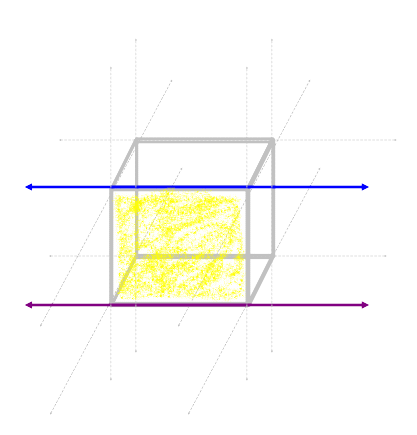
following figure, can you identify all parallel lines?
Solution:
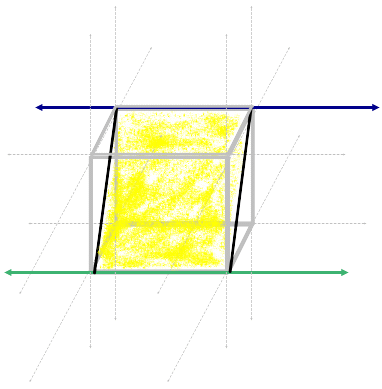
If we can identify all of the lines that are on the same plane we would
then know which lines are parallel.
Here we see that both the
purple and blue lines are on the yellow plane and since they are on the
same plane and do not intersect these lines are parallel. These lines
seem to be going in the same direction, but are they parallel? Since we
can identify that we have two lines on each plane, we would be able to
state that we have parallel lines. Would the red and blues or the
purple and green lines be parallel?
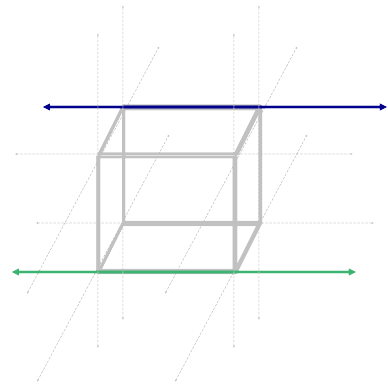
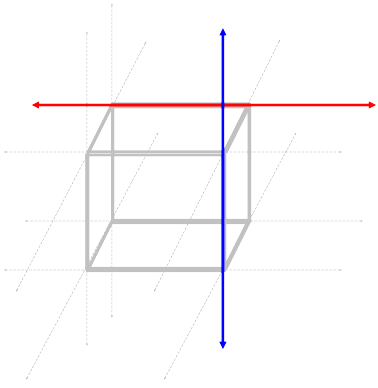
Look at this figure Could the
blue and green lines be parallel? Could we make these two lines to
be on the same plane? Here we see
that both of the lines are on the same plane, so yes these lines are
parallel
Watch the video:
Example C
Problem:
Given the following figure, can you identify all skew lines?
Solution:
Lines
that are skew to each other will not intersect and will not be on the
same plane.
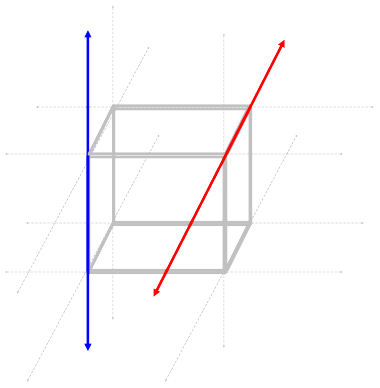
If we look at the red and blue lines they are not on
the same plane and do not intersect. However if
we were view the figure from the right side, we would see: So the
lines do not intersect and are not on the same plane, so they are skew
Watch the video:
Quick Question...
Instructions:
Identify if the lines are either Intersecting,
Parallel, or Skew
To use the app:
Clickto
begin, click
for full screen mode
Clickto
check your answer
Clickto goto the next problem
Clickto stop the app
Now you do...
Use Geogebra Cube App below to create a pair of lines that are :
Parallel
Skew
Intersecting
Practice Problems
Use the Geogebra Cube App to create the following lines
Identify if the
lines are either parallel. skew or intersecting
Take a screenshot of the figure and paste into the Jamboard for
this assignment
A. Line: AB Line: CG
Are the lines: Parallel " // ". Skew or Intersecting?
B. Line: AG Line: CE
Are the lines: Parallel " // ". Skew or Intersecting?
C. Line: HB Line: FG
Are the lines: Parallel " // ". Skew or Intersecting?
D. Use the POLYGON tool to shade in a pair of parallel sides.
Assignment:
Use the Geogebra Cube App to create the following lines
Identify if the
lines are either parallel. skew or intersecting
Take a screenshot of the figure and paste into the Jamboard for
this assignment
1. Line: CB Line: HG
Are the lines: Parallel " // ". Skew or Intersecting?
2. Line: CD Line: FG
Are the lines: Parallel " // ". Skew or Intersecting?
3. Line: DE Line: FB
Are the lines: Parallel " // ". Skew or Intersecting?
4. Line: EB Line: HA
Are the lines: Parallel " // ". Skew or Intersecting?
5. Line: CB Line: HD
Are the lines: Parallel " // ". Skew or Intersecting?
6.. Line: CH Line: AF
Are the lines: Parallel " // ". Skew or Intersecting?
7.. Line: AD Line: HC
Are the lines: Parallel " // ". Skew or Intersecting?
8.. Line: CB Line: HG
Are the lines: Parallel " // ". Skew or Intersecting?
9.. Line: CA Line: HF
Are the lines: Parallel " // ". Skew or Intersecting?
10. Use the POLYGON tool to shade in 3 intersecting sides.
Note: shade each side a different color
 to
begin, click
to
begin, click
 for full screen mode
 to
check your answer
to
check your answer to goto the next problem
 to stop the app