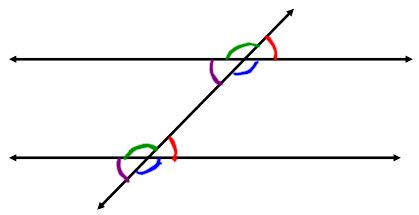
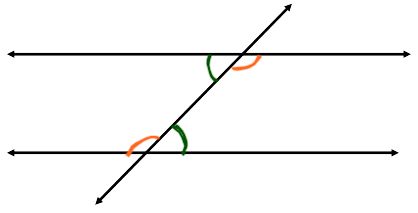
When 2-lines are in the same plane and do not intersect, we say that these lines are parallel.
A transversal line is any line that crosses two or more lines or parallel lines.
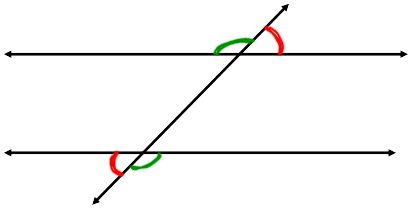
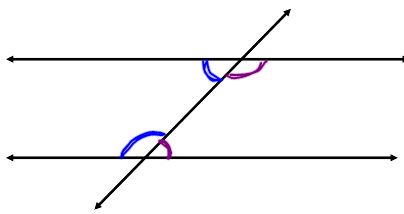
When a transversal crosses parallel lines there are many angles formed, These angle are related in very specific ways
Note: The second statement is called the converse. This switches the order so that we have another statement that we can use.
|
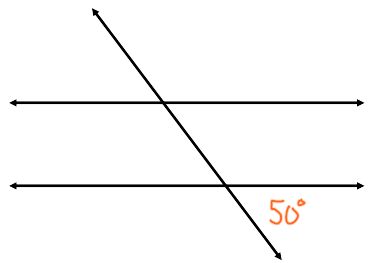
Problem: Given the following figure, identify all angle measurements if the lines are parallel..
|
Solution: We are given the angle measure of 50o in the bottom right angle. We can use our knowledge of the angles formed by intersecting lines to find the other angles in the intersection of the transversal with the bottom line. We know that the adjacent angle to the right of 50o and above the 50o will form a linear pair. So each of these angles will be 130o. 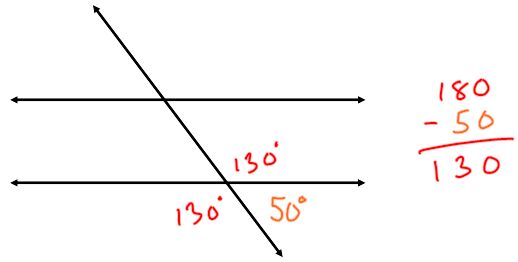 Next we use the Vertical Angles Theorem (VAT) to justify the angle on the top left. So now we have: 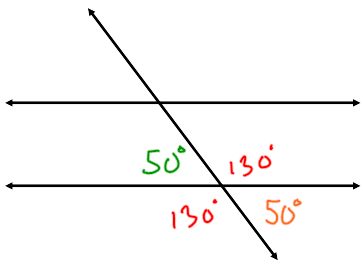 Now we can use the Corresponding Angles Postulate to fill in the rest of the angles. Since we were given parallel lines we know that the intersection of the transversal with the other line will form the exact same angles, thus the same angle in the same place on the top intersection will have the exact same angle measures as the bottom intersection. So now we get: 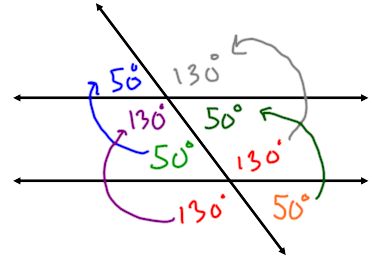 |
Watch the video: |
|
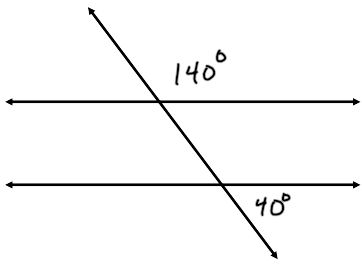
Problem Given the following figure, identify all angle measurements. How can we justify that the lines are parallel?
|
Solution: . Before we begin it might be helpful to label the angles in some way. Since we are not given and points, we can simply number the angles as follows: 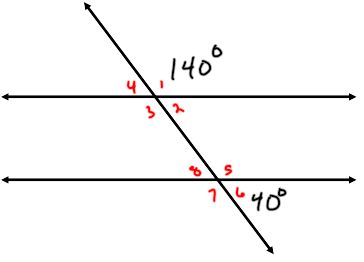 Now it will be easier to identify the other angle measures. By the Linear Pair Theorem, we know that  5
&
7
we know that their measures will both be 140o.Likewise,
2
&
4
will be 40o. So now we
have: 5
&
7
we know that their measures will both be 140o.Likewise,
2
&
4
will be 40o. So now we
have: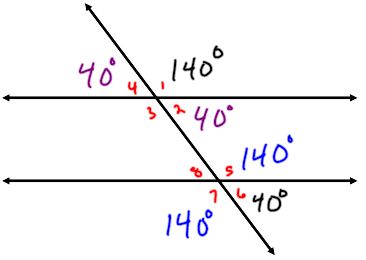 Next we can use the Vertical Angles Theorem to find 3
&
8.
So
3
= 140o &
8
= 40o. So we now have: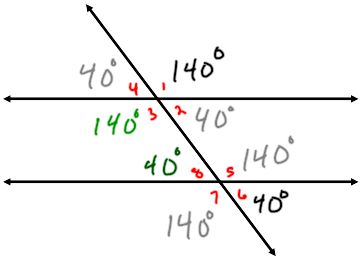 Now that we have all of the angle measures identified, we can see that 2
=
8
&
3
=
5.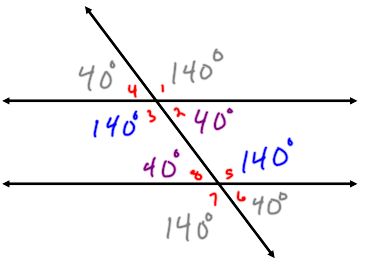 Then by the Converse of the Alternate Interior Angles Theorem the lines are parallel. |
Watch the video:> |
|
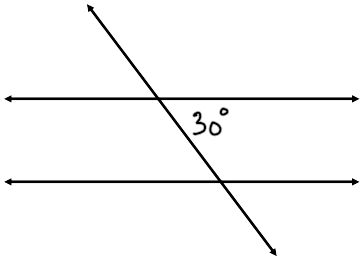
Problem: Given the following figure, These 2-lines are parallel and are cut by a transversal, identify the exterior angle measurements.
|
Solution: Again we can number the angle to help us out. The order used to identify each angle really does not matter, we could have even used letters. 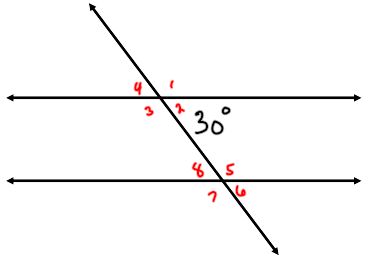 Next we can use the Linear Pair Theorem and the Vertical Angles Theorem to find 1
&
4.
So now we have: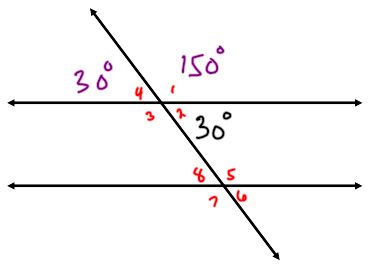 Since we were given that the lines are parallel, we can use the Alternate Exterior Angles Theorem to find the measures of 6
&
7.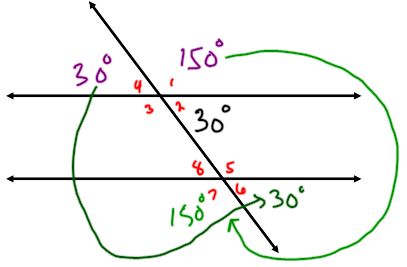 So we now know that 6
= 30o &
4
= 150o |
Watch the video:> |
|
Problem: Given the following figure, verify that the same side interior angle theorem can be used to justify that the lines are parallel.. 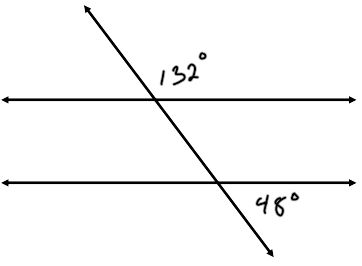 |
Solution: If we use the Vertical Angles Theorem we can get the following: 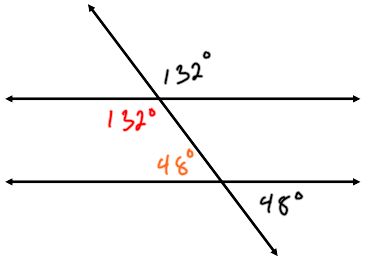 And since... 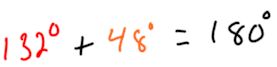 ... is true. By the Same-Side Interior Angles Theorem we can justify the statement that these 2-lines are parallel. |
Watch the video: |
|
Instructions:
To use the app:
Back to Example A,
B, C,
D |
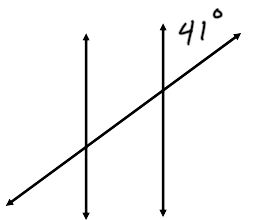
A. Assume the vertical lines are parallel, draw out the figure and identify all of the angle measurements. |
 |
B. Assume the vertical lines are parallel, if 1
= 151o what is
8
= ?Explain which postulate and/or theorem you used to justify your answer. |
Use this figure for Practice Problem B - G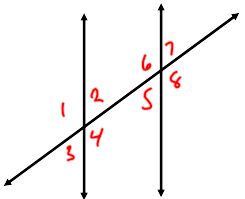 |
| C. Assume the vertical lines are parallel,
if
2
= 51o what is
5
= ? Explain which postulate and/or theorem you used to justify your answer. |
|
| D. Assume the vertical lines are parallel,
if
3
= 63o what is
6
= ? Explain which postulate and/or theorem you used to justify your answer. |
|
| E If
3
= 49o and
7
= 49o , are the lines
parallel? Explain which postulate and/or theorem you used to justify your answer. |
|
| F. If
3
= 49o and
6
= 131o , are the lines
parallel? Explain which postulate and/or theorem you used to justify your answer. |
|
| G. If
1
= 157o and
7
= 33o , are the lines
parallel? Explain which postulate and/or theorem you used to justify your answer. |
.
 to
begin, click
to
begin, click
 for full screen mode
 to
check your answer
to
check your answer to goto the next problem
 to stop the app