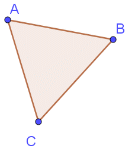
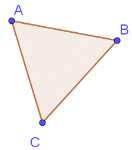
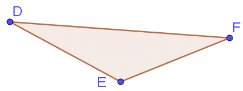
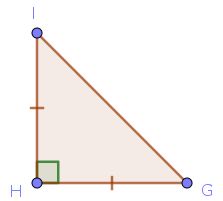
Triangle:A triangle is a three-sided closed figure ( polygon ). A triangle can be classified by its angles ( total of 180o) or by its sides. To name a triangle we simply use a Δ followed by the letters of each vertex. So the triangle on the right is named: ΔABC |
![]() |
| Acute Triangle: | Obtuse Triangle: | Right Triangle: |
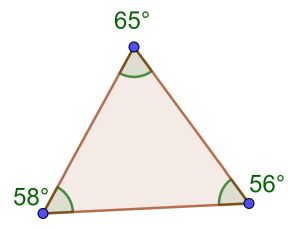
| Any triangle that has three acute angles is an acute triangle. |
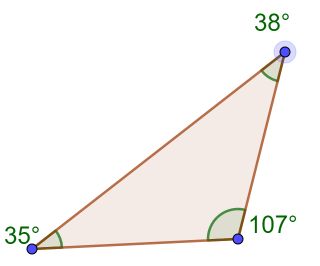
Any triangle that has one obtuse angle is an obtuse triangle. |
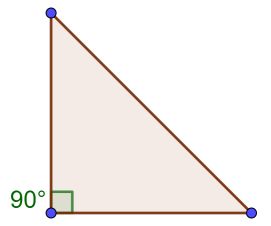
Any triangle that has one right angle is a right triangle. |
![]() |
![]() |
![]() |
Note: A special kind of acute triangle is an Equiangular Triangle ( Regular Triangle ), which has three congruent angles.
| Use Geogebra to create an
Equiangular Triangle
|
Step: 1. Plot Points: A & B 2. Create Segment AB 3. Create Angle ABA' = 60° 4. Create Segment BA' 5. Create Angle BAB' = 60° 6. Create Segment AB' 7. Identify Measure of Angle AB'B You now have an Equiangular Triangle Press Try it for yourself in the Sandbox |
|
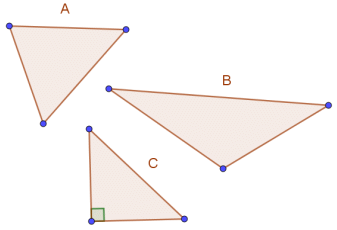
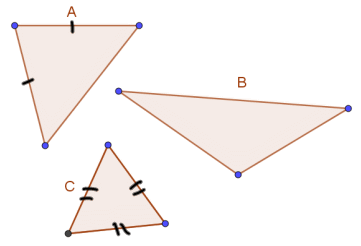
Problem: Given the following figures, identify, if possible, the type of triangles by their angle measurements.. |
Solution: Most of the time we are given an idea of what the angle measures are. If we look at Triangle C we can see that that it has a right angle in it, so we can conclude that it is a right triangle. But what about triangles A & B? Since we have no angle measurements given to us, we will identify the triangles by observation. Since triangle A seems to have all acute angles, it would be an acute triangle. Since triangle B seems to have an obtuse angle, it would be an obtuse triangle. Triangle A: Acute Triangle Triangle B: Obtuse Triangle Triangle C: Right Triangle |
Watch the video: |
|
Quick Question... Instructions:
To use the app:
|
| Scalene Triangle: | Isosceles Triangle: | Equilateral Triangle: |
| Any triangle that does not have any congruent sides is a scalene triangle. |
Any triangle with
at least two congruent sides is an isosceles triangle. |
Any triangle that has three congruent sides is an equilateral triangle ( Regular Triangle ). |
![]() |
![]() |
![]() |
| Use Geogebra
to create a Scalene Triangle with sides of length 3, 4, & 5
|
Step: 1. Plot Point: A 2. Create Segment AB with length = 3 3. Create Circle A with Radius = 4 4. Create Circle B with Radius = 5 5. Create Point: C at either intersection of the circles 6. Create Segment AC 7. Create Segment BC 8. Identify length of: Segment AC Segment BC You now have a Scalene Triangle with sides of length 3, 4, & 5 Press Try it for yourself in the Sandbox |
|
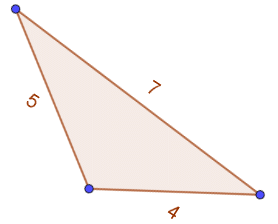
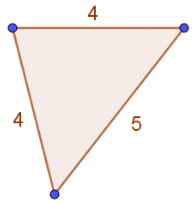
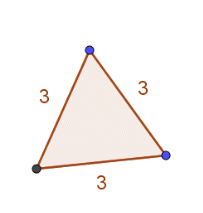
Problem: Given the following figures, identify, if possible, the type of triangles by their sides.
|
Solution: We can not really determine the type of triangles by observation when identifying the triangles by their sides. This time we will need more information, either side lengths or marks. Since triangle A has marks on two of its sides and these marks identify congruent sides, we can conclude that it is an isosceles triangle. Triangle B has no marks on any of its sides, so we can conclude that none of the sides are congruent. Thus triangle B is a scalene triangle. Triangle C has marks on each side and they are the same marks, so we can conclude that all of the sides on this triangle are the same. Therefore triangle C is equilateral. Triangle A: Isosceles Triangle Triangle B: Scalene Triangle Triangle C: Equilateral Triangle |
Watch the video:> |
|
Quick Question... Instructions:
To use the app:
|
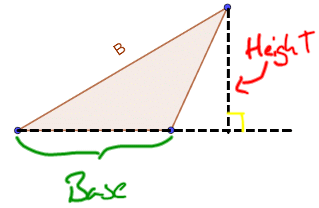
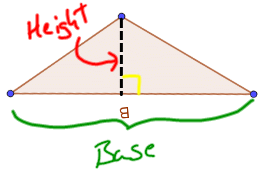
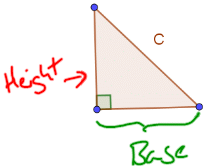
| Base of a Triangle: | Height of a Triangle: | Vertex of a Triangle: |
| Can be any one of the
triangle’s sides, but we usually identify the base as the side that is on the bottom of the triangle. |
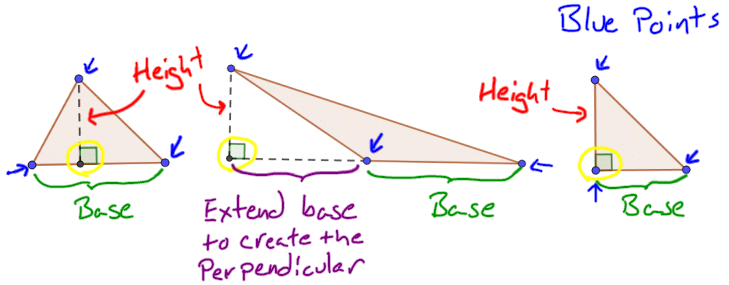
A perpendicular segment from
a vertex to the line containing the opposite side ( base ). The length of that segment is called the height. |
Is one of the points where
two sides of the triangle intersect. |
![]() |
||
| Use Geogebra
to create a Triangle with a base of length 5 and height of
length 4
|
Step: 1. Plot Point: A 2. Create Circle A with Radius = 5 3. Create Point B on Circle A 4. Create Line AB 5. Create Circle B with Radius = 4 6. Create a perpendicular line to Line AB at Point B 7. Create Point C at the top intersection of Circle B and the perpendicular line to Line AB at Point B 8. Create a Parallel Line to Line AB at Point C 9. Create Point: D on the line parallel to Line AB 8. Create a Perpendicular Line to Line AB at Point D 9. Create Point: E at the intersection of the perpendicular line through Point D and Line AB 10. Identify Measure of Angle DEA 11. Create Segment AB 12. Create Segment AD 13. Create Segment BD 14. Create Segment DE 15. Identify the measure of Segment AB and Segment DE You now have a Triangle with a base of length 5 and height of length 4 Press You can hide the objects that you don't want to see by selecting the object and then uncheck "Show Object" Try it for yourself in the Sandbox |
|
Problem: Given the following figures, Identify a possible base and height for each triangle. ![]() |
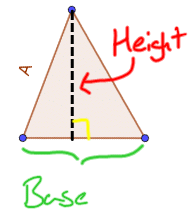
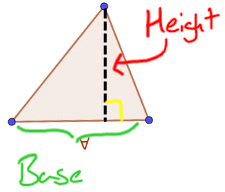
Solution: Starting with triangle A we can identify any of the three sides as a base and then identify the height to the other vertex that is not on the base. ![]() ![]() Likewise with triangle B we can identify the base and the height using any of the three sides. ![]() ![]() And the same goes for triangle C. Even though it is a right triangle we could really identify any of the three sides as the base. Although, it is quicker to use the sides that form the right triangle. ![]() |
Watch the video:> |
|
Quick Question... Instructions:
To use the app:
|
| A. Which triangle is obtuse? |
![]() |
![]() |
![]() |
|
| B. Which triangle is acute?
|
||||
| C. Which triangle is a
right isosceles triangle? |
||||
| D.
Are any of the triangles scalene? If so, then which ones are scalene? |
||||
| E. Use Geogebra to make an equilateral triangle |
||||
| F. Is the triangle you made in
"E" also equiangular? Use Geogebra to justify your answer. |
||||
| G. Use Geogebra to make an
obtuse triangle. Then identify the the Base & Height 3-different ways. |
||||
| H. Use Geogebra to make a
triangle with side lengths of 6, 8, & 10 | ||||
.
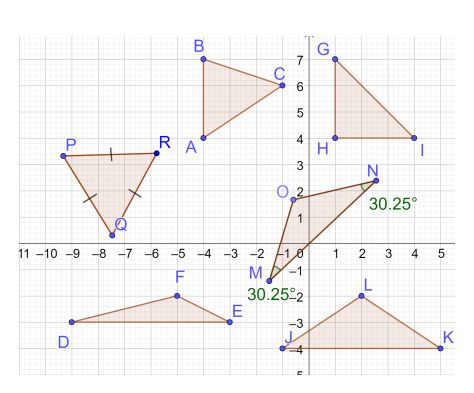
| Given the figures on the right identify
any & all triangles that are: 1. Acute |
![]() |
| 2. Obtuse |
|
| 3. Right |
|
| 4. Scalene |
|
| 5 Equilateral |
|
| 6. Isosceles |
|
| Using Geogebra, create the following
triangles: 7. Acute Triangle with a 36o angle. |
|
| 8. Acute Triangle
with a base of 5 & height of 6. |
|
| 9. Obtuse Triangle
with a 143o
angle. |
|
| 10. Obtuse Triangle
with a base of 8 & height of 3. |
|
| 11. Right Triangle with a
base of 7 & height of 24. |
|
| 12. What is the length of the other side
of the triangle in #11? |
|
| 13. Do you believe that any Right Triangle will always have side lengths that will always be whole numbers? Explain why you gave that answer. |
|
|
14. Scalene Triangle with a
73o
angle. |
|
|
15. Scalene Triangle with a base of 3 & height of 4. |
|
| 16. Isosceles Triangle with a 52o
angle. |
|
|
17. Isosceles Triangle with a base of 5 & height of 5. |
|
| 18. Equilateral Triangle with a side length of 7 |
|
| 19. What is the measure of any angle found in the triangle you created in #18? |
|
| 20. Are all of the angles the same in the triangle you created in #18? |
|
| 21. Is the triangle you created in #18, an equiangular triangle? |
|
| 22. Are ALL equilateral triangles also equiangular triangles? Explain your answer. |
|
| 23. Given that this floor joist has identical boards making the triangles in the joist, and that the angle measures are also all the same. What kind of triangle is created? |

![]() |
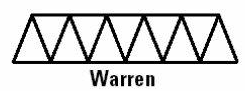
| 24. Identify all of the possible triangles
( what types of triangles ) shown in the Warren Bridge. |
![]() |
| 25. Identify all of the possible
triangles ( what types of triangles ) shown in the Warren (with Verticals) Bridge. |

![]() |
|
|