So: m
 A
+ mB
+
mC
= 180o
A
+ mB
+
mC
= 180o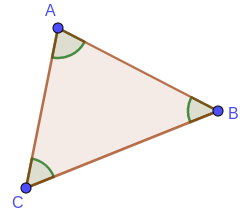
| The sum of the measures of the angles of a
triangle is equal to 180°. So: m A
+ mB
+
mC
= 180o |
|
Note : We will be using some new symbols to be
used for representing angle measurement variables.
"Alpha" = α, "Beta" = β,
"Gama" = γ, "Delta" = δ, "Epsilon" = ε, "Zeta" = ζ,
"Eta" = η
|
Question: Does the Triangle Sum Theorem always work? |
Solution: Yes, it does! You can use the Geogebra app to verify for yourself. |
Step: 1. Create Polygon (Triangle) ABC 2. Identify Measure of Angle ABC (α= ) 3. Identify Measure of Angle BCA (β= ) 4. Identify Measure of Angle CAB (γ= ) 5. Using  click on
 if
needed if
needed- Press "=" - Click  then then - Type "α+β+γ" then press "Enter" You now have a Triangle with the sum of the angles = 180o You can move the points A, B, & C to see if the sum always is = 180o Press  or or to run the Geogebra build simulation.
Try it for yourself in the Sandbox Watch the video: |
|
Quick Question... To Answer:
To use the app:
|
(A corollary to a theorem is a statement that follows directly from that theorem. )
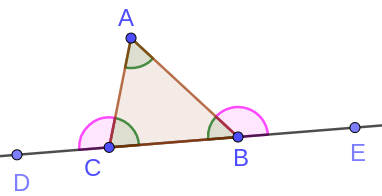
| The measure of each exterior
angle of a triangle is equal to the sum of the measures of its two
remote interior angles. So: m ABE
= mBAC
+ mACBand m ACD
= mBAC
+ mCBA |
 |
|
Question: Does the Exterior Angle Theorem always work? |
Solution: Yes, it does! You can use the Geogebra app to verify for yourself. |
Step: 1. Create Polygon (Triangle) ABC 2. Create Line BC 3. Create Point D, to the left of Point C 4. Create Point E, to the right of Point B 5. Identify Measure of Angle ABC (α= ) 6. Identify Measure of Angle BCA (β= ) 7. Identify Measure of Angle CAB (γ= ) 8. Identify Measure of Angle ACD (δ= ) 9. Identify Measure of Angle EBA (ε= ) 5. Use "Input" to do the following: - Type "=α+γ" then press "Enter" - Type "=β+γ" then press "Enter" You will now see that: (Angle CAB) + (Angle ABC) = (Angle ACD) & (Angle CAB) + (Angle ACB) = (Angle ABE) You can move the points A, B, & C to see if these sums are always equal Press or
to run the Geogebra build simulation.Try it for yourself in the Sandbox Watch the video: |
|
Quick Question... To Answer:
To use the app:
|
|
 |
|
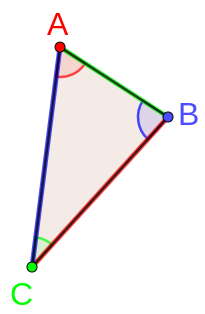
Problem: Is this Triangle Relationship always true? |
Solution: Yes, it is! You can use the Geogebra app to verify for yourself. |
Watch the video: |
|
Quick Question... To Answer:
To use the app:
|
|
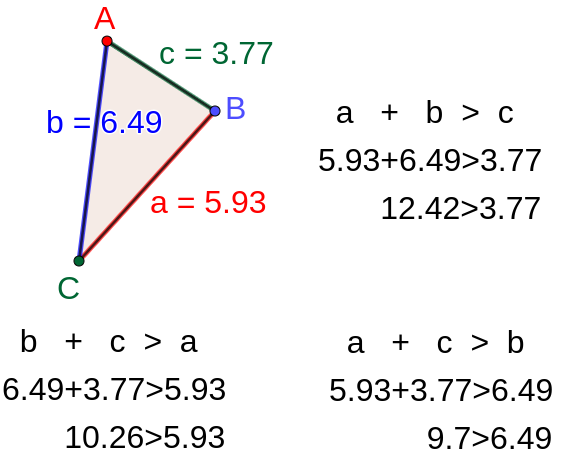
The sum of the lengths of any two sides of a triangle must be greater than the length of the third side. AND... If you have or choose any 2-sides of a triangle, then:
Note: This idea is the BIG
IDEA for triangles. If you have three segments of |
 |
|
Problem: Is the Triangle Inequality Theorem always true |
Solution: Yes, it is! You can use the Geogebra app to verify for yourself. |
Watch the video: |
|
| ||
|
Quick Question... To Answer:
To use the app:
|
| Try this! |
Given the segments on the left: Try to make 3-triangles, 1-blue, 1-green & 1-red triangle. Can you make make 3-triangle using any colors (sides) you want? |
|
|
|
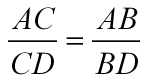
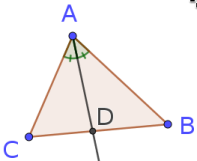
If a line bisects an angle of a triangle, then it divides the opposite sides proportionally to the other two sides of the triangle
|
 |
|
Problem: Is this Triangle Angle Bisector Theorem always true? |
Solution: Yes, it is! You can use the Geogebra app to verify for yourself. |
Watch the video: |
|
| ||
|
Quick Question... To Answer:
To use the app:
|
A. In ΔABC,  A
= 51o and
B
= 15o , what is the measure
of
C
? A
= 51o and
B
= 15o , what is the measure
of
C
? |
|
| B. In the figure on the right,
if
ABE
= 125o and
A
= 15o , what are the measures of B
&
C
? |
|
| C. In ΔABC, if the following is true:
A
>
B
>
C, put the sides in order of length from least to greatest. |
|
D. If possible, use Geogebra to create ΔABC,
where = 7,
= 7,
 = 8, and
 = 9?
= 9? |
 |
| E If possible, use Geogebra to create ΔABC,
where
= 10,
= 20, and
= 30? |
|
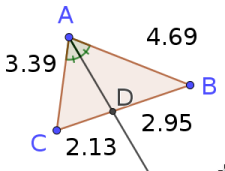
| F. Use the Triangle Angle Bisector Theorem
to verify that ΔABC, on the right, is bisected by  . . |
|
|
|
|
| G. Use the Triangle Angle Bisector Theorem
with ΔABC, on the right, to find the length of  if
= 3.81,
= 3.96,
if
= 3.81,
= 3.96,
 =
2.43 =
2.43 |
.
1. In ΔABC, A
= 107o and B
=
49o , what is the measure of
C
? |
|
| 2. ΔABC is an Obtuse Isosceles
Triangle with B
=
17o what could the measures of A
&
C
be? |
|
| 3. Is it possible to create an Equilateral
Triangle with an angle measure of 45o
? If possible, use Geogebra to create this triangle. |
|
| 4. Is it possible to create a Right
Triangle with an angle measure of 45o
? If possible, use Geogebra to create this triangle. |
|
| 5 Is it possible to create an Isosceles
Triangle with both base angle measures of 85o
? If possible, use Geogebra to create this triangle. |
|
| 6. If
ACD
= 123o and
B
= 55o , what are the measures of A
&
C
? |
Figure for problems 6-9: |
| 7. If
B
= 60o and
C
= 60o , what are the measures of A
&
ABE? |
|
| 8. If
B
= 74o and
A
= 27o , what is the measure of ACD? |
|
| 9. Use Geogebra to create the figure
on the right,
where
C
= 49o andABE
= 113o . Find all of
the remaining angle measures. |
|
| 10. In ΔABC,
<,
<
.Use Geogebra
to create the triangle, Then list the the angles in order from least to greatest. |
|
| 11. In ΔABC, if
≤,
≤,
.is
it possible for
A
<
B? |
|
|
12. If possible, use Geogebra to create ΔABC,
where
= 9,
= 5, and
= 3? |
|
| 13. In ΔABC,
where
= 16 and
= 23 what is the largest possible length that
could be to make a triangle? |
|
| 14. In ΔABC,
where
= 16 and
= 23 what is the smallest possible length that
could be to make a triangle? |
|
| 15. Use the Triangle Angle Bisector Theorem
with ΔABC, on the right, to find the length of
if
= 4.26,
= 5.41,
=
2.11 |
|
| 16. Use the Triangle Angle Bisector Theorem
with ΔABC, on the right, to find the length of
if
=
2.59,
= 4.51,
=
3.14 |
|
| 17. Use the Triangle Angle
Bisector Theorem with ΔABC, on the right, to find the length of
if
= 3.81,
= 3.96,
=
2.43 |
|
| 18. Use the Triangle Angle
Bisector Theorem with ΔABC, on the right, to find the length of
if
= 5.16,
= 3.9,
=
3.53 |
|
| 19. Use the Triangle Angle
Bisector Theorem with ΔABC, on the right, to find the length of
if
= 4.45,
= 4.65,
=
1.83 |
|
| 20. Use the Triangle Angle Bisector
Theorem to verify that ΔABC, on the right, is bisected by ,
if
= 4.95,
= 5.7,
=
4.84, and=
5.57 |
|
 to
begin, click
to
begin, click
 for full screen mode
 to
check your answer.
to
check your answer. to goto the next problem
 to stop the app