3.1  Types of Quadrilaterals 


Quadrilaterals:


A quadrilateral is a polygon with four sides. Quadrilaterals are classified according to the number of congruent and parallel sides they have. Some quadrilaterals can be named in several ways. For example, a square is also a rectangle, a rhombus, and a parallelogram

Which leads us to the Hierarchy of Quadrilaterals and the Definitions of each Quadrilateral:
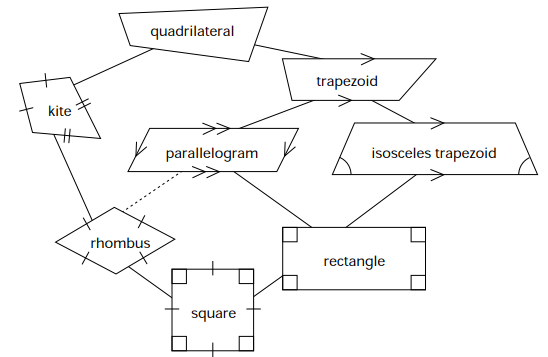
 
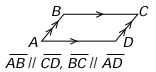
A quadrilateral is a parallelogram if and only if both pairs of its opposite sides are parallel.  
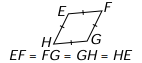
A quadrilateral is a rhombus if and only if its four sides are equal in length.   
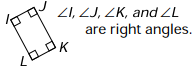
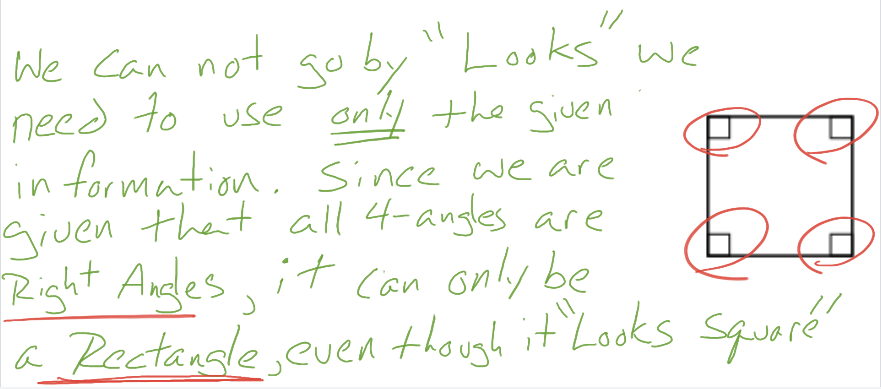
A quadrilateral is a rectangle if and only if it has four right angles.   
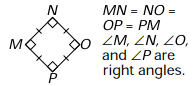
A quadrilateral is a square if and only if it has four equal sides and four right angles.   
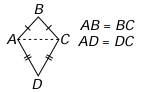
A quadrilateral is a kite if and only if it has two distinct pairs of consecutive sides of the same length.   
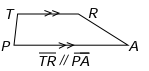
A quadrilateral is a trapezoid if and only if it has at least one pair of parallel sides.   


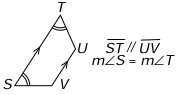
A quadrilateral is an isosceles trapezoid if and only if it has at least one pair of parallel sides and a pair of base angles equal in measure. 

Note: Remember that in an Isosceles Triangle, base angles and legs are congruent, this also applies to an Isosceles Trapezoid .  An Isosceles Trapezoid can be constructed out of and Isosceles Triangle.
 

Example A

Question:

Use the markings on the quadrilateral to give it as specific a name as possible?


Watch the video:

Solution:


Quick Question...

Instructions:

  • Click on the specific name of the given polygon
  • Click on the "Stopwatch" for a 30 second timer
  • Use the slider to select the numbers of questions

To use the app:

  • Clickto begin, click for full screen mode
  • Clickto check your answer.
  • Clickto goto the next problem
  • Clickto stop the app


Example B

Question:

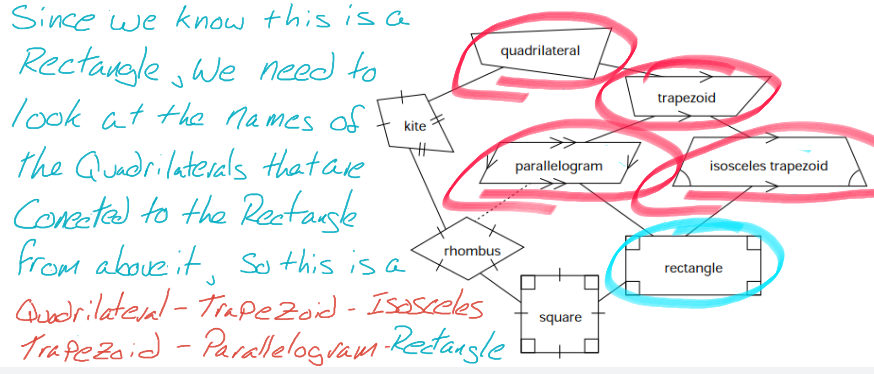
Use the markings on the quadrilateral to identify ALL of the possible names of this figure?


Watch the video:

Solution:


Quick Question...

Instructions:

  • Click on all possible names of the given polygon
  • Click on the "Stopwatch" for a 30 second timer
  • Use the slider to select the numbers of questions

To use the app:

  • Clickto begin, click for full screen mode
  • Clickto check your answer.
  • Clickto goto the next problem
  • Clickto stop the app


Example C

Question:

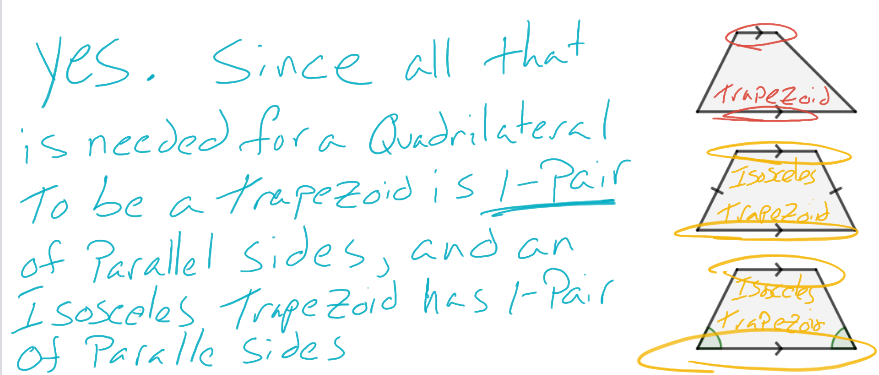
Are all Isosceles Trapezoids, Trapezoids?


Watch the video:

Answer:


Quick Question...

Instructions:

  • Click on the True or False
             All means ALL ARE
             Some means, SOME ARE and SOME ARE NOT
  • Click on the "Stopwatch" for a 30 second timer
  • Use the slider to select the numbers of questions

To use the app:

  • Clickto begin, click for full screen mode
  • Clickto check your answer.
  • Clickto goto the next problem
  • Clickto stop the app


Practice Problems

A.  Can a quadrilateral be both a kite and a trapezoid?  Explain your answer.
     
B.  Use what you know about points, lines & angles to make a parallelogram
      using Geogebra.
   
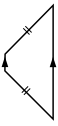
C.  Use the markings on the quadrilateral, on the right, to give it as specific a name as possible.


Assignment:

1.  Can a quadrilateral be both a rectangle and a rhombus?  Explain your answer.
    
 
2.  True or False, is every rectangle a square?

 
3.  True or False, is every square a rectangle
    
 
4.  True or False, if a quadrilateral has three sides the same length, then it is a kite
    
 
5.  Use what you know about points, lines & angles to make a kite using Geogebra.
    
 
6.  Use what you know about points, lines & angles to make a rhombus using Geogebra.
    
 
7.  Use what you know about points, lines & angles to make a square using Geogebra.
    
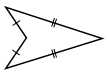
8.  Use the markings on the quadrilateral, on the right, to give it as specific a name as possible.
    
9.  Use the markings on the quadrilateral, on the right, to give it as specific a name as possible.
    
10. Use the markings on the quadrilateral, on the right, to give it as specific a name as possible.