3.2  Properties of Kites 


Kites:


Kites are quadrilaterals classified according to their sides.  The sides of a quadrilateral are either congruent , kites, or they are parallel, trapezoids. Angles are only used to identify a few very specific quadrilaterals; Isosceles Trapezoids, Rectangles, & Squares.

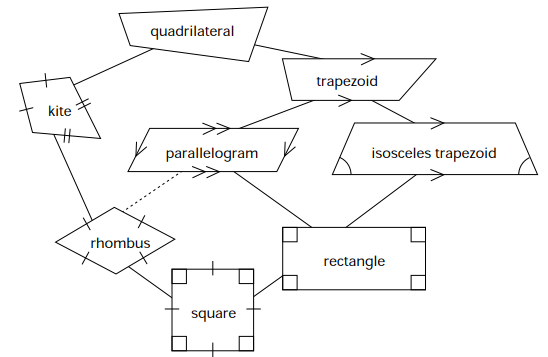
Hierarchy of Quadrilaterals:

Properties of a Kite:

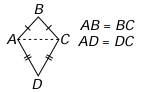
  • A quadrilateral is a kite if and only if it has two distinct pairs of consecutive sides of the same length.  


  • Kites have two different shapes
        
     
  • Kites have diagonals, both the "Kite" and "Arrow" have a long diagonal ( going from the top end to the bottom end ), but only the "Kite" has a 2nd short diagonal.
      
  • Kites are symmetrical along the long diagonal.


  • The long diagonal is the perpendicular bisector of the short diagonal and is also the angle bisector of the top and bottom angle of a "Kite"
     
     
  • The angles formed by two non-congruent sides are congruent.
 
      
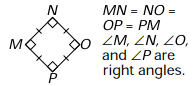
Standard Kite "Kite":     &     Arrow Head "Arrow"

Kite, 2-diagonals           &      Arrow, 1-diagonal  


Properties of a Rhombus:

Have all of the properties of a Kite and:

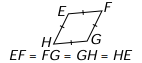
  • A quadrilateral is a rhombus if and only if its four sides are equal in length.


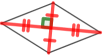
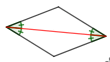
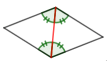
  • The diagonals of a rhombus are perpendicular bisectors of each other


  • The diagonals of a rhombus are angle bisectors of the opposite angles at the ends of each diagonal segment.


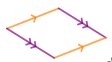
  • The pairs of opposite sides ( pair-1 & pair-2 ) of a rhombus are parallel.
    Note: for this reason and this reason only, a rhombus is also a parallelogram.  Which is there is a dotted line between them in
    the diagram.

     
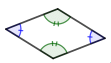
  • The pairs of opposite angles ( pair of acute angles & pair of obtuse angles ) of a rhombus are congruent.


       &    


Properties of a Square:

Have all of the properties of a Rhombus & Rectangle* and:                                              *Note: we will learn about Rectangles in 3.3

  • A quadrilateral is a square if and only if it has four equal sides and four right angles. 


  • The diagonals of a square are:
 
  • congruent to each other.
  • perpendicular bisectors of each other.
     
  • angle bisectors of the opposite angles at the ends of each diagonal segment.
     
    
  • The pairs of opposite sides ( pair-1 & pair-2 ) of a square are parallel.


Example A

Problem:

Use Geogebra to create a Kite


Solution:

Step:
1.  Plot 3-points: A, B, & C
2.  Create Circle A, through Point C
3.  Create Circle B, through Point C
4.  Create Point D at the other intersection of the 2-circles
5.  Create the following segments:
      -  Segment AD
      - 
Segment AC
      - 
Segment BD
    
 -  Segment BC
6.  Identify the congruent segments.

You now have a Kite

Press or to run the Geogebra build simulation.


     Watch the video:

Problem

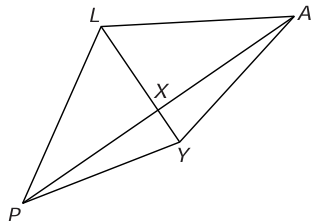
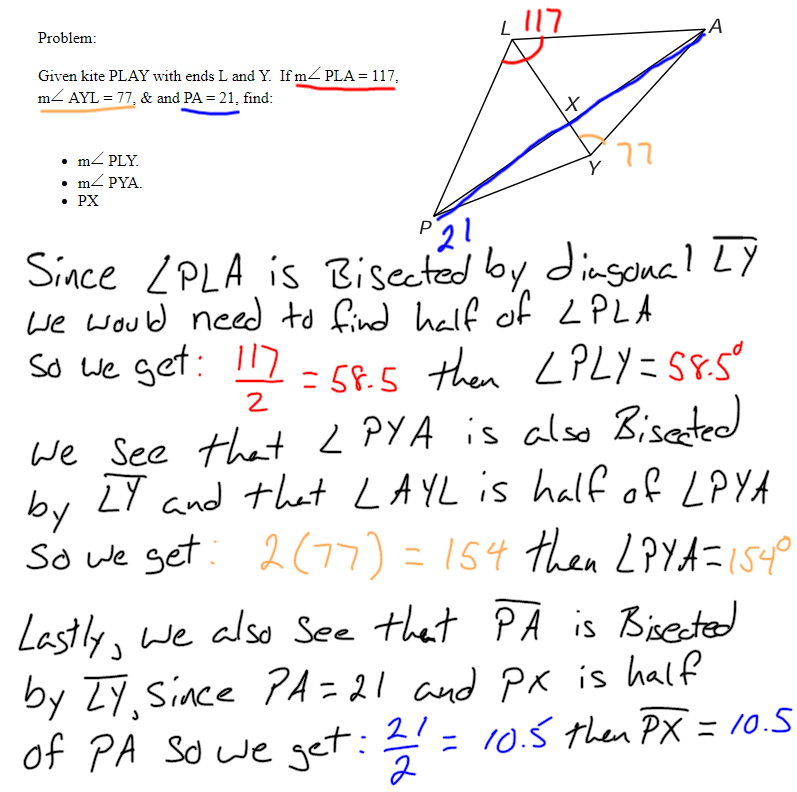
Given kite PLAY with ends L and Y,  If  mPLA = 117°, mAYL = 77°, & PA =21. Find:
  • mPLY
     
  • mPYA
     
  • PX

Quick Question...

Instructions:

  • Use the given "keypad" to enter your answer
  • Click on the "Stopwatch" for a 30 second timer
  • Use the slider to select the numbers of questions

To use the app:

  • Clickto begin, click for full screen mode
  • Clickto check your answer.
  • Clickto goto the next problem
  • Clickto stop the app
 

Example B

Modify the steps used to create a Kite, to create a Rhombus

Solution:

Step:
1.  Plot 3 2-points: A, B, & C
2.  Create Circle A, through Point B C
3.  Create Circle B, through Point A C
4.  Create Point C & Point D at the both other    
      intersections
of the 2-circles
5.  Create the following segments:
      -  Segment AD
      - 
Segment AC
      - 
Segment BD
    
 -  Segment BC
6.  Identify the congruent segments.

You now have a Rhombus

Press or to run the Geogebra build simulation.


     Watch the video:
Problem:

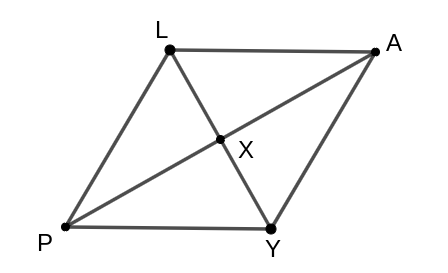
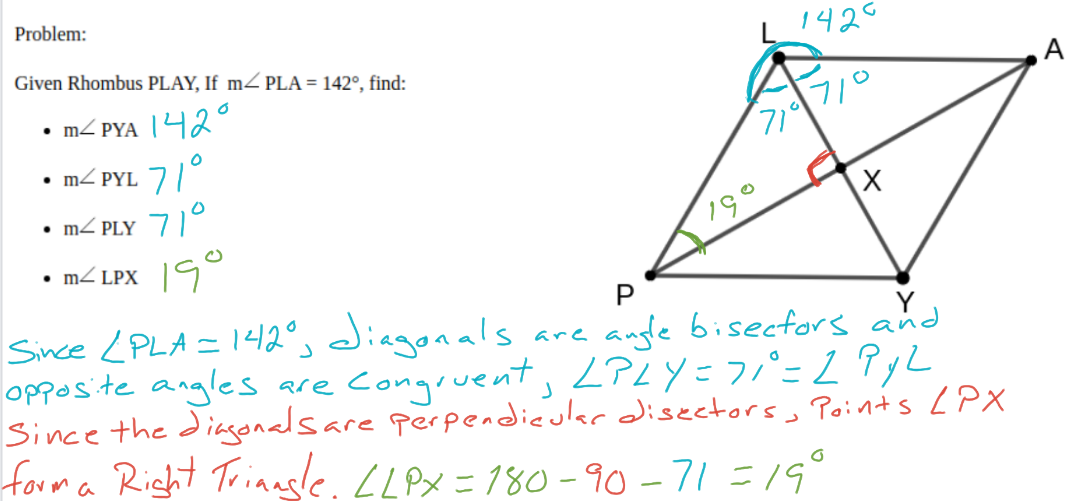
Given Rhombus PLAY, If  mPLA = 142°, find:
  • mPYA
     
  • mPYL
     
  • mPLY
     
  • mLPX


Quick Question...

Instructions:

  • Use the given "keypad" to enter your answer
  • Click on the "Stopwatch" for a 30 second timer
  • Use the slider to select the numbers of questions

To use the app:

  • Clickto begin, click for full screen mode
  • Clickto check your answer.
  • Clickto goto the next problem
  • Clickto stop the app


Example C

Problem:

Modify the steps used to create a Rhombus, to create a Square


Solution:

Step:
1.  Plot 3 2-points: A, B, & C
2.  Create Circle A, through Point B C
3.  Create Circle B, through Point A C
4.  Create Segment AB
5.  Create a line perpendicular to Segment AB
      through Point
A
6.   Create Point C at an intersection of the
      perpendicular line and Circle A.

7. 
Create Segment AC
8.  Create
a line perpendicular to Segment AB
      through Point
B
9.   Create Point D at the intersection of the
      perpendicular line and Circle B, on the
      same side of
Segment AB that Point C is on
      intersections
of the 2-circles
5.  Create the following segments:
      - 
Segment BD
      -  Segment DC

6.  Identify the congruent segments
      and the Right Angles


You now have a Square

Press or to run the Geogebra build simulation.


Watch the video:
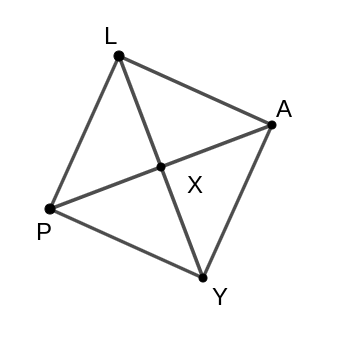
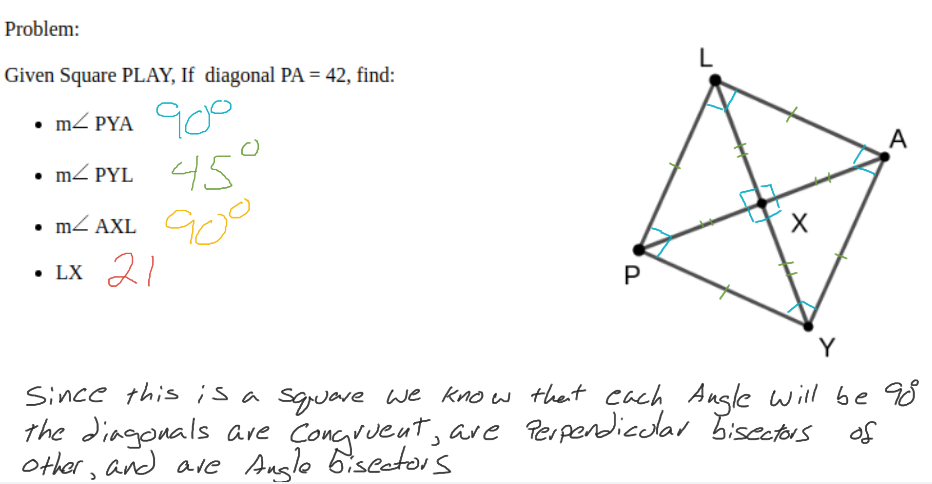
Problem:

Given Square PLAY, If  diagonal PA = 42, find:
  • mPYA
     
  • mPYL
     
  • mAXL
     
  • LX


Quick Question...

Instructions:

  • Use the given "keypad" to enter your answer
  • Click on the "Stopwatch" for a 30 second timer
  • Use the slider to select the numbers of questions

To use the app:

  • Clickto begin, click for full screen mode
  • Clickto check your answer.
  • Clickto goto the next problem
  • Clickto stop the app


Practice Problems

A.  Draw the symmetry line for COAL
     
B.  Draw OL & label the intersection point as M.
   
C.  Identify all congruent segments and angles.
    
D.  If mOAL = 80° & mLCM = 30°, find the measure of the remaining angles


Assignment:

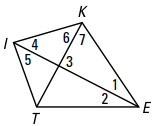
1.  Use kite KITE with ends I and E. If m1 = 29°, and mKIT = 88°, find each angle measure.
    

  • m2 =
     
  • mKET =
     
  • m3 =
     
  • m5 =
  • m6 =
     
  • m7 =
     
  • m4 =
     
  • mITE =
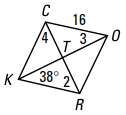
2.  CORK at the right is a rhombus. Find each length and each angle measure.

  • OR =
     
  • RK =
     
  • m2 =
     
  • mKCO =
  • m4 =
     
  • m3 =
     
  • mCOR =
     
  • mKTR =
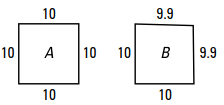
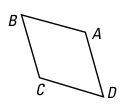
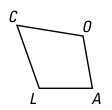
3.  Use the markings to give as specific a name as possible for quadrilateral A & .quadrilateral B.
    
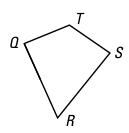
4.  Draw the diagonal line(s) for kite QRST identify the line of symmetry, mark all right angles,
     mark all congruent angles and segments.
    
5.  Draw the symmetry line(s) for rhombus ABCD, mark all right angles, mark all congruent
     angles and segments.
    
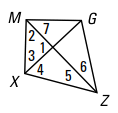
6. At the right, M and Z are the ends of kite MGZX, m2 = 46°, and mGZX = 64°.
    Find each measure
    
  • m7 =
     
  • m3 =
     
  • m4 =
     
  • m1 =
  • m5 =
     
  • m6 =
     
  • mZGM
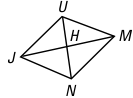
7.  In rhombus UMNJ, UH = 14 and mUMH = 31°.
  
  • Give as many segment lengths as possible.
     
  • Give as many angle measures as possible.
     
  • Give as many pairs of parallel segments as possible.
     
  • Give as many isosceles triangles as possible.
     
  • Which triangles are congruent?
        
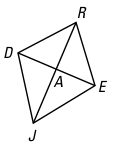
8.  In rhombus REJD, mDRE  =  82°. Find each measure.
    
  • mDRA  =
     
  • mDJA  =
     
  • mRDA  =
     
  • mJDR  =
9.  How many symmetry diagonals does a kite have?
    
 
10. How many symmetry diagonals does a rhombus have?