3.3  Properties of Trapezoids 


Trapezoids:


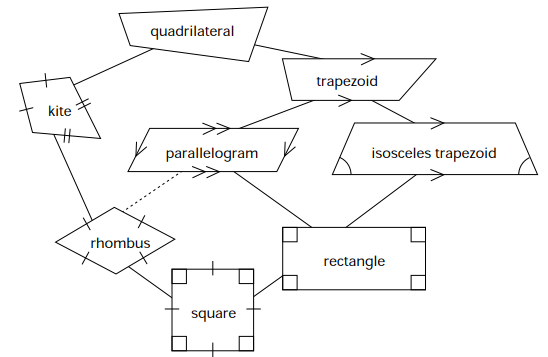
Quadrilaterals are classified according to their sides.  The sides of a quadrilateral are either congruent , kites, or they are parallel, trapezoids. Angles are only used to identify a few very specific quadrilaterals; Isosceles Trapezoids, Rectangles, & Squares.

Hierarchy of Quadrilaterals and the Definitions of each Quadrilateral:
 

Properties of a Trapezoid:

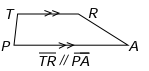
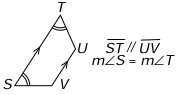
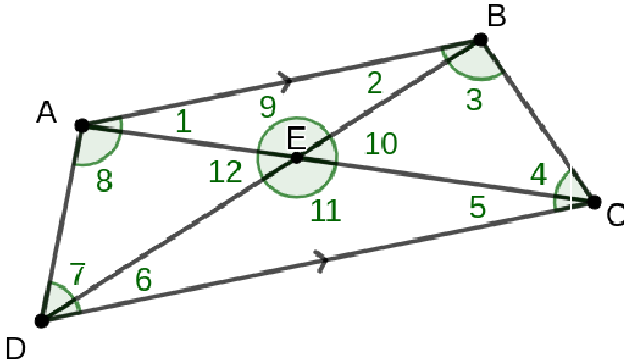
  • A quadrilateral is a trapezoid if and only if it has at least one pair of parallel sides.


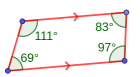
  • In a trapezoid, consecutive angles between a pair of parallel sides
    are supplementary, Same Side Interior Angles


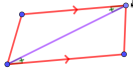
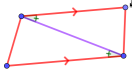
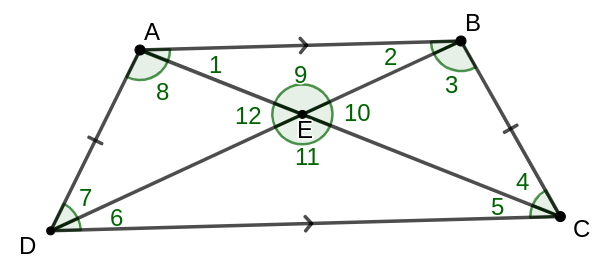
  • In a trapezoid, alternate interior angles of the diagonal are
    congruent
 
      
111° + 69° = 180° 83° + 97° = 180°


      and 

Properties of an Isosceles Trapezoid:

Have all of the properties of a Trapezoid and:

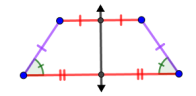
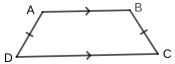
  • A quadrilateral is an isosceles trapezoid if and only if it has at least one pair of parallel sides and a pair of base angles equal in measure. 


  • In an isosceles trapezoid, the non-base sides ( not parallel sides )
    are congruent.


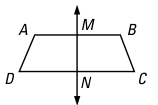
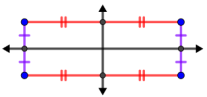
  • In an isosceles trapezoid, line of symmetry is created by a line going
    through the midpoints of the parallel sides ( bases ).


Properties of a Parallelogram:

Have all of the properties of a Trapezoid and:

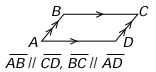
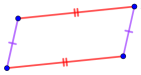
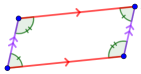
  • A quadrilateral is a parallelogram if and only if both pairs of its opposite sides are parallel.


  • In a parallelogram, opposite sides are congruent


  • In a parallelogram, opposite angles are congruent


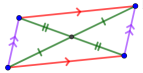
  • In a parallelogram, the diagonals bisect each other.


Properties of a Rectangle:

Have all of the properties of an Isosceles Trapezoid & Parallelogram and:

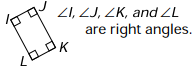
  • A quadrilateral is a rectangle if and only if it has four right angles. 


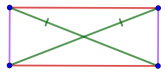
  •   In a rectangle, the diagonals are congruent.


  • In a rectangle, the lines of symmetry is created by a line going
    through the midpoints of opposite sides.


Example A

Problem:

Use Geogebra to create  Trapezoid


Solution:

Step:
1.  Create segment AB
2.  Create point C, not on AB
3.  Create segment BC
4.  Create a line Parallel to segment AB
    
through point C
5.  Create point D on the line parallel to AB,
     on the same side of BC as point A
6.  Create the following segments:
     - Segment AD
     - Segment DC

You now have a Trapezoid

Press or to run the Geogebra build simulation.
Watch the video:

Problem

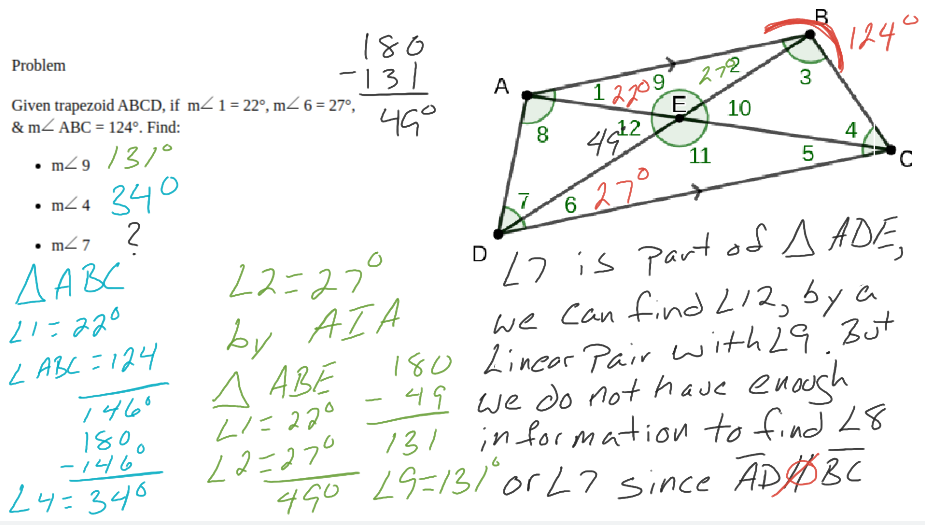
Given trapezoid ABCD, if  m1 = 22°, m6 = 27°,
& mABC = 124°. Find:
  • m9
     
  • m4
     
  • m7

Quick Question...

Instructions:

  • Use the given "keypad" to enter your answer
  • Click on the "Stopwatch" for a 30 second timer
  • Use the slider to select the numbers of questions

To use the app:

  • Clickto begin, click for full screen mode
  • Clickto check your answer.
  • Clickto goto the next problem
  • Clickto stop the app


Example B

Problem:

Modify the steps used to create a Trapezoid to create an Isosceles Trapezoid in Geogebra


Solution:

Step
1.  Create segment AB
2.  Create the Perpendicular Bisector of
      segment AB.
3.  Create Point z any where on the
     perpendicular bisector
4.  Create a Parallel Line, through point Z
     parallel to segment AB
5.
. Create point C, not on AB any where on the
     parallel line
6.  Create a Circle with Center at point Z
     through point C
7.
  Create segment BC
8
  Create a line Parallel to segment AB
     through point C
9
Create point D at the intersection of the
      the circle and the parallel on the side with
     point A

10.  Create the following segments:
     - Segment AD
     - Segment DC

You now have a Parallelogram

Press or to run the Geogebra build simulation.
Watch the video:


Problem

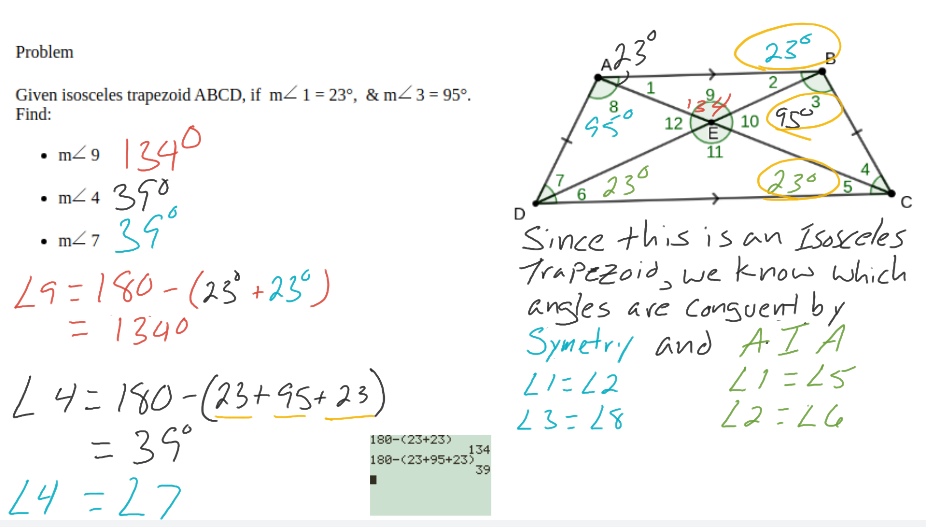
Given isosceles trapezoid ABCD, if  m1 = 23°,  & m3 = 95°. Find:
  • m9
     
  • m4
     
  • m7


Quick Question...

Instructions:

  • Use the given "keypad" to enter your answer
  • Click on the "Stopwatch" for a 30 second timer
  • Use the slider to select the numbers of questions

To use the app:

  • Clickto begin, click for full screen mode
  • Clickto check your answer.
  • Clickto goto the next problem
  • Clickto stop the app


Example C

Problem:

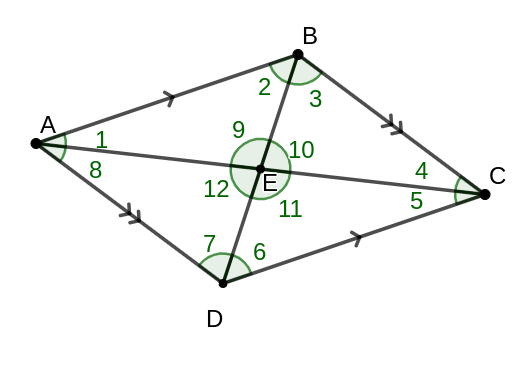
Modify the steps used to create a Trapezoid to create a Parallelogram in Geogebra


Solution:

Step
1.  Create segment AB
2.  Create point C, not on AB
3.  Create segment BC
4.  Create a line Parallel to segment AB
    
through point C
5.  Create a line Parallel to segment BC
    
through point A
6.  Create point D on the line parallel to AB,
     on the same side of BC as point A at the
     intersection of the 2-parallel lines

7.  Create the following segments:
     - Segment AD
     - Segment DC

You now have a Parallelogram

Press or to run the Geogebra build simulation.
Watch the video:


Problem

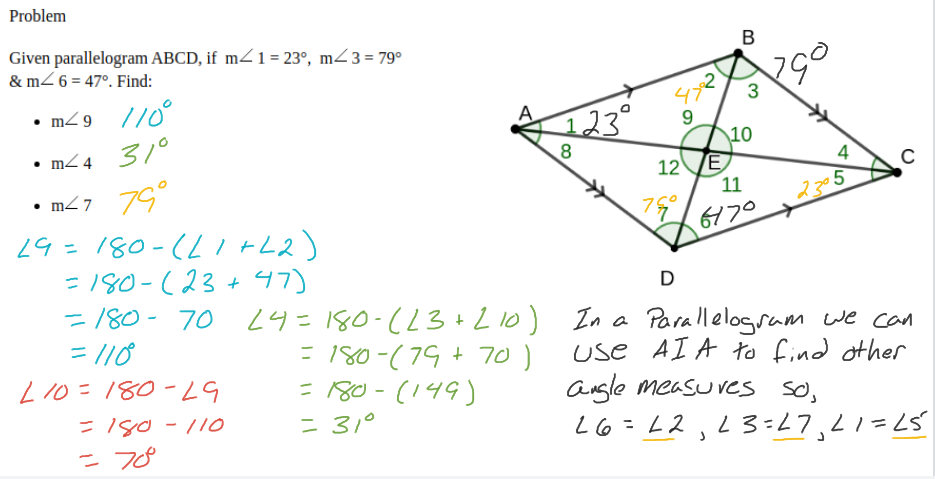
Given parallelogram ABCD, if  m1 = 23°,  m3 = 79°
& m6 = 47°. Find:
  • m9
     
  • m4
     
  • m7
 

Quick Question...

Instructions:

  • Use the given "keypad" to enter your answer
  • Click on the "Stopwatch" for a 30 second timer
  • Use the slider to select the numbers of questions

To use the app:

  • Clickto begin, click for full screen mode
  • Clickto check your answer.
  • Clickto goto the next problem
  • Clickto stop the app
 

Example D

Problem:

Modify the steps used to create a Parallelogram to create a Rectangle in Geogebra

Solution:

Step:
1.  Create segment AB
2.  Create a line Perpendicular to segment AB
     through point B
3.  Create point C, not on AB on the perpendicular
     line, doesn't matter where you put the point.

4.  Create segment BC
5.  Create a line Parallel to segment AB
    
through point C
6Create a line Parallel to segment BC
    
through point A
7Create point D on the line parallel to AB,
     on the same side of BC as point A at the
     intersection of the 2-parallel lines

8.  Create the following segments:
     - Segment AD
     - Segment DC

You now have a Rectange

Press or to run the Geogebra build simulation.
Watch the video:
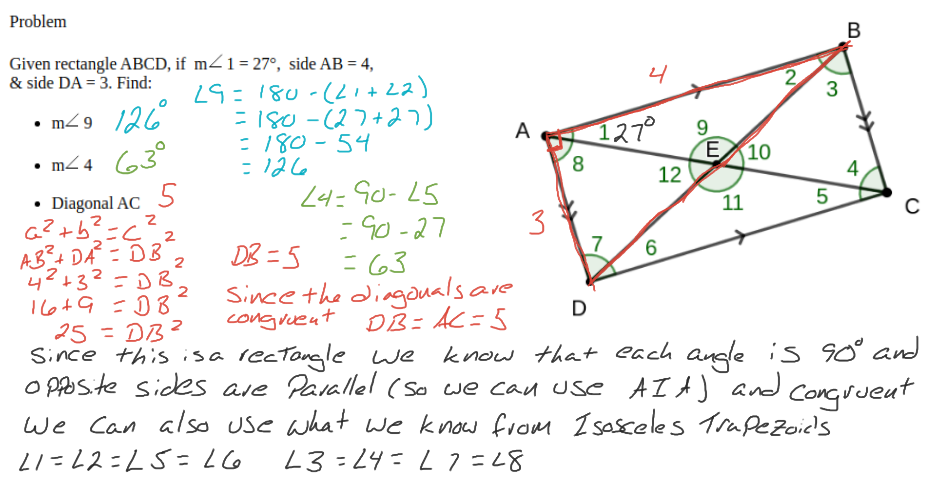
Problem

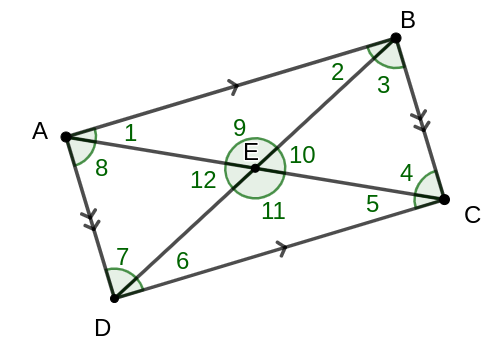
Given rectangle ABCD, if  m1 = 27°,  side AB = 4,
& side DA = 3. Find:
  • m9
     
  • m4
     
  • Diagonal AC


Quick Question...

Instructions:

  • Use the given "keypad" to enter your answer
  • Click on the "Stopwatch" for a 30 second timer
  • Use the slider to select the numbers of questions

To use the app:

  • Clickto begin, click for full screen mode
  • Clickto check your answer.
  • Clickto goto the next problem
  • Clickto stop the app
 

Example E

Problem:

Modify the steps used to create a Rectangle to create a Square in Geogebra


Solution:

Step:
1.  Create segment AB
2.  Create a line Perpendicular to segment AB
     through point B
3.  Create a Circle with center point B,
     Through point A.

4Create point C, not on AB on the perpendicular
     line,
doesn't matter where you put the point.
     at the intersection with the circle
5.  Create segment BC
6.  Create a line Parallel to segment AB
    
through point C
7Create a line Parallel to segment BC
    
through point A
8Create point D on the line parallel to AB,
     on the same side of BC as point A at the
     intersection of the 2-parallel lines

9.  Create the following segments:
     - Segment AD
     - Segment DC
You now have a Square

Press or to run the Geogebra build simulation.
Watch the video:


Practice Problems

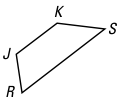
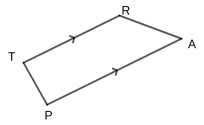
A.  Suppose TRAP is a trapezoid with bases TR and AP,  with mP = 45°, and mR = 93°.  
      Find each measure


  • mA =
  • mT =
B. In ABCD with mD =64°
     Find each measure
   
  • mB =
  • mC =
C. True or False, Every square is an isosceles trapezoid.
    
D. In PARL, with mL =53°
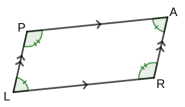
     Find each measure
   
  • mP=
  • mA=
  • mR =


Assignment:

1. RS and JK are the bases of trapezoid JKSR, with mK = 133° and mR = 61°.

    Find each measure
  • mJ =
  • mS =
2.  MN is a symmetry line for trapezoid ABCD, with mD = 74°, AB = 28, AD = 12, and DC = 34.6.

     Find each measure.
    
  • mC =
     
  • mA =
     
  • mAMN =
  • BC =
     
  • DN =
     
  • MB =
     
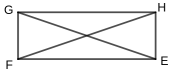
3.  In rectangle EFGH, GF = 7, FE = 24,

     Find, HF = ?    


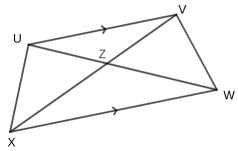
4.  In UVWX, mZUV = 21°, mUXZ = 62°,  mZXW = 27°, and mVWZ = 36°.

     Find the measure of each angle:.
    
  • mUVZ =
     
  • mUZV =
     
  • mUZX =
     
  • mXUZ =
  • mVZW =
     
  • mZVW =
     
  • mXZW =
     
  • mXWZ =
5.  Do any isosceles trapezoids have more than one
     symmetry line? Explain why or why not.
    
 
6.  Can an isosceles trapezoid have a symmetry
     diagonal? Explain why or why not.
    
 
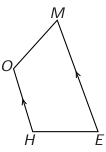
7.  In trapezoid HOME, HO // ME. If mO = 118°,

     Find the measures of as many other angles as you can.
    
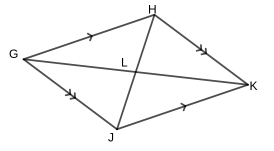
8.  GHJK is a parallelogram with HJ = 33, mGHK = 124°, and mGKH = 31°..

     Find as many other lengths and angle measures as possible.
    
  • mGHL =
     
  • mHLG =
     
  • mLGH =
     
  • mGLJ =
     
  • mGJK =
  • mGJL =
     
  • mJGL =
     
  • mJLK =
     
  • mLJK =
     
  • mJGH =
  • mLKJ =
     
  • mKLH =
     
  • mKHL =
     
  • mLKH =
     
  • mHKJ =
  • HL =
     
  • JL =
     
  • GL =
     
  • KL =
     
  • GK =
9.  If you were given the following information, in addition to what you are given in #8,
     GL = 21 and mHLK = 77°.

     find the measures of as many other angles as you can.
      
 
  • mGHL =
     
  • mHLG =
     
  • mLGH =
     
  • mGLJ =
     
  • mGJK =
  • mGJL =
     
  • mJGL =
     
  • mJLK =
     
  • mLJK =
     
  • mJGH =
  • mLKJ =
     
  • mKLH =
     
  • mKHL =
     
  • mLKH =
     
  • mHKJ =
  • HL =
     
  • JL =
     
  • GL =
     
  • KL =
     
  • GK =
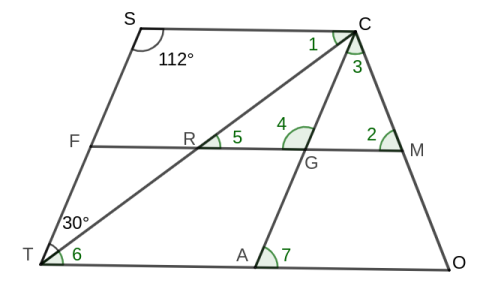
10.  Given the figure above, where ST // CA, SC // FM, FM // OT,
       CACO, TASC, FTMO, F is the midpoint of ST,
       G is the midpoint of CA, M is the midpoint of CO
       find the measure of the following angles.

       1 =    , 2 =    , 3 =    , 4 =    , 5 =    , 6 =    , 7 =

  • m1 =
     
  • m2  =
     
  • m3  =
     
  • m4 =
  • m5 =
     
  • m6  =
     
  • m7  =