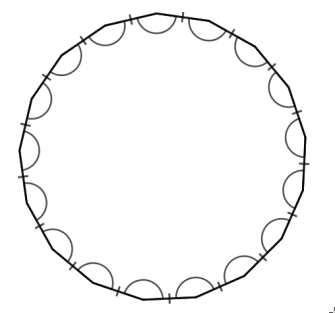
A polygon is a closed plane figure
formed by three or more segments. Each segment intersects
exactly two other segments only at their endpoints. No
two segments with a common endpoint are collinear.
A polygon is concave
if any diagonal can be drawn between two nonconsecutive
vertices and a part of that segment lies outside of the
polygon.
A polygon is convex if
all diagonals can be drawn between two nonconsecutive
vertices and stay inside of the polygon.
These are notpolygons
Types of Polygons:
Any polygon can be identified as one of these
four classifications:
A polygon is irregular if it
all sides are not
congruent and all angles are not congruent.
A polygon is equilateral
if all sides are congruent.
A polygon is equiangular
if all angles are congruent.
A polygon is regular
if all sides are congruent and all angles are congruent.
Note: we do not need to identify a regular polygon as equilateral
and equiangular, since
it is both by definition.
Names of Polygons:
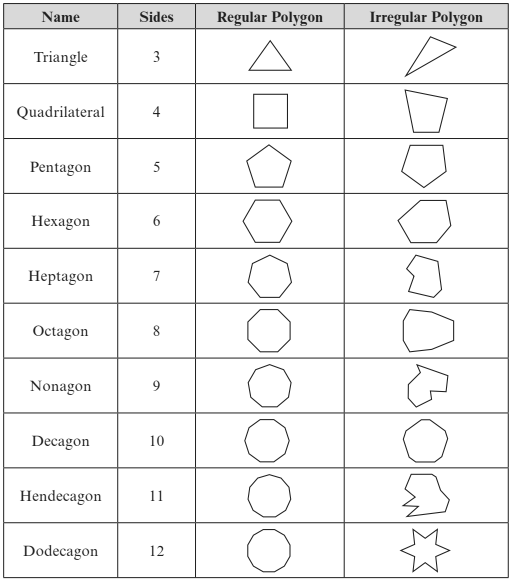
Polygons are named by the number of sides they have. The following chart
shows some common polygons and their names. If a polygon does not have a
specific name, it can be called an n-gon. For example, if
we have a 13 sided polygon we would simply call it a "13-gon".
Polygon Angle Theorems:
Formula for the Sum of the Interior Angles of a
Convex Polygon:
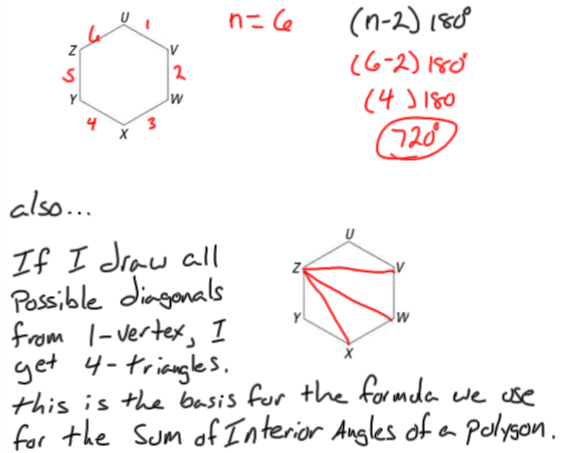
To find the sum of the
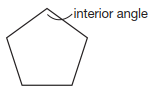
interior angles of a convex polygon, use the formula
below, where n is the number of sides of
the polygon.
(n - 2)180º
Formula for Interior Angle Measure of a
Regular Polygon
To find the measure of
each interior angle of a regular
polygon, use the formula below, where n
is the number of sides of the polygon.
(n - 2)180° n
Formula for Exterior
Angle Measure of a Regular Polygon
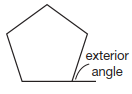
To find the exterior angle measures of a
regular polygon, use the formula below,
where n is the number of sides in the
polygon.
360°
n
Example A
Question:
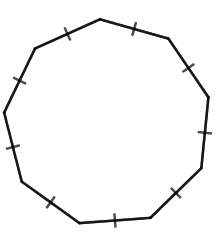
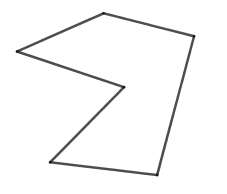
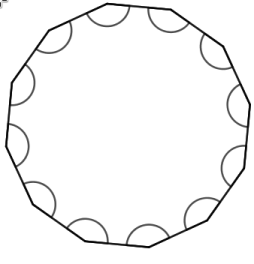
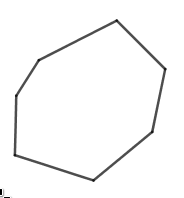
Name and classify each polygon, determine whether it is equiangular,
equilateral, regular, irregular, convex or concave.
Answer:
Watch the video:
Name: Pentagon equiangular convex
Name: Heptagon equilateral concave
Name: Dodecagon irregular convex
Name: Quadrilateral equiangular convex
Quick Question...
Instructions:
Click on the name & classifications of the given polygon
Click on the "Stopwatch" for a 30 second timer
Use the slider to select the numbers of questions
To use the app:
Clickto
begin, click
for full screen mode
Clickto
check your answer.
Clickto goto the next problem
Clickto stop the app
Example B
Question:
In the following polygon, what is the sum of the
interior angles in the regular hexagon UVWXYZ?
Watch the video:
Solution:
Quick Question...
Instructions:
Click on the name & find the sum of the interior angle
measures
Click on the "Stopwatch" for a 30 second timer
Use the slider to select the numbers of questions
To use the app:
Clickto
begin, click
for full screen mode
Clickto
check your answer.
Clickto goto the next problem
Clickto stop the app
Example C
Question:
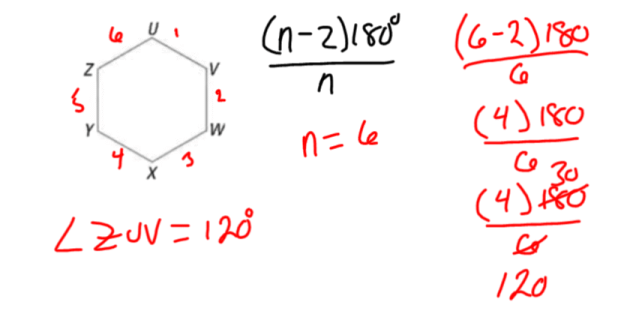
In the following polygon, what is the mZUV
in the regular hexagon UVWXYZ?
Watch the video:
Solution:
Quick Question...
Instructions:
Click on the name & find the interior angle measure
Click on the "Stopwatch" for a 30 second timer
Use the slider to select the numbers of questions
To use the app:
Clickto
begin, click
for full screen mode
Clickto
check your answer.
Clickto goto the next problem
Clickto stop the app
Example D
Question:
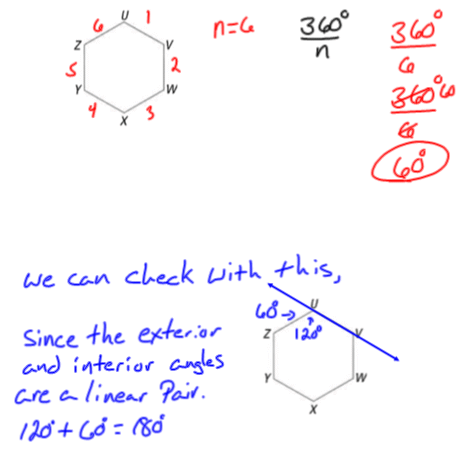
In the following polygon, what is the measure of the
exterior angle at ZUV
in the regular hexagon UVWXYZ?
Watch the video:
Solution:
Quick Question...
Instructions:
Click on the name & find the exterior angle measure
Click on the "Stopwatch" for a 30 second timer
Use the slider to select the numbers of questions
To use the app:
Clickto
begin, click
for full screen mode
Clickto
check your answer.
Clickto goto the next problem
Clickto stop the app
Practice Problems
A.
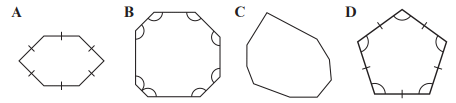
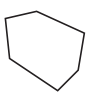
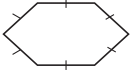
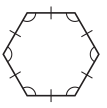
Name and classify each polygon on the right, determine whether it is equiangular, equilateral, regular, irregular, convex or concave.
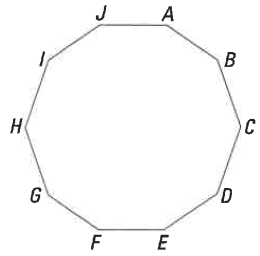
B. In the regular polygon ABCDEFGHIJ on the
right, find the interior angle
measure of DEF
.
C. In the regular polygon ABCDEFGHIJ on the right, find the
exterior angle measure of HIJ,
D. In the regular
polygon ABCDEFGHIJ on the right, find the
sum of the interior angles.
Assignment:
For each given polygon do the following:
Name the polygon.
Classify each polygon as either: equiangular, equilateral, regular, irregular.
Determine if the polygon is convex or concave.
If possible, find the sum of the interior angles. If you
can not find the measures, explain why you can not.
If possible, find the measure of each interior angle. If you
can not find the measures, explain why you can not.
If possible, find the measure of each exterior angle. If you
can not find the measures, explain why you can not.
1.
2.
3.
4.
5.
For each of the
following problems use Geogebra to create the polygon with the
following:
Identify congruent sides
Identify congruent angles
Identify one interior angle measure, for equiangular polygons
6. Create a Regular 14-gon
7. Create an equiangular, equilateral,
convex quadrilateral






 to
begin, click
to
begin, click
 for full screen mode
 to
check your answer.
to
check your answer. to goto the next problem
  to stop the app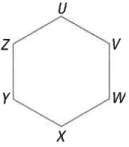
 ZUV
in the regular hexagon UVWXYZ?
ZUV
in the regular hexagon UVWXYZ?