 symbol
and the center point. For example,
A is
read, “circle A.”
symbol
and the center point. For example,
A is
read, “circle A.”
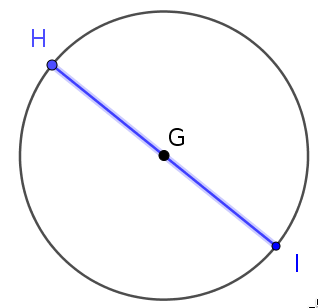
A circle is the set of points in a plane that are a fixed
distance from a given point. This point is called the center of the circle. To
name a circle, use the
symbol
and the center point. For example,
A is
read, “circle A.”
|
 |
|
 |
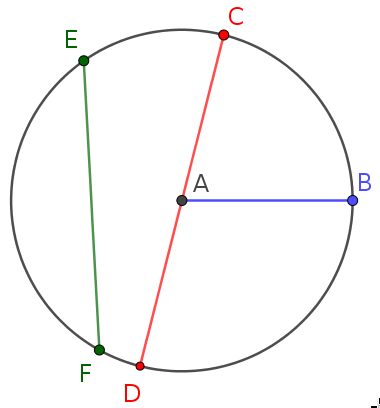
| Task: Use Geogebra to create A,
with radius AB = 4, diameter CD, and
chord EF
|
Solution: Step: 1. Plot Point A 2. Create Circle: Center A & Radius 4 3. Create Point B, anywhere on the circle. 4. Create Radius AD ( Segment AD ) 5. Create Point C, anywhere on the circle. 6. Create Line AC. 7. Create Point D, at the other intersection of line AC and the circle. 8. Create Diameter CD ( Segment CD ) 9. Create Points E & F, such that Segment EF will not go through Point A, then create Segment EF You now have A,
with radius AB = 4, diameter CD, and
chord EFPress  or or to run the Geogebra build simulation.
Watch the video: |
|
Quick Question... Instructions:
To use the app:
|
|
Question: What is the circumference of the circle in Example A? 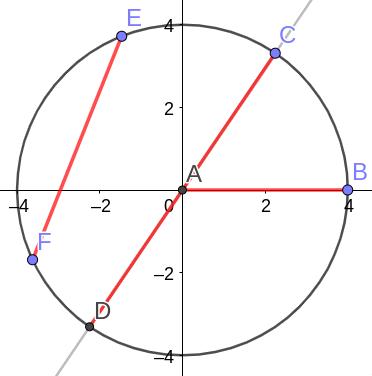 |
Watch the video: |
Solution: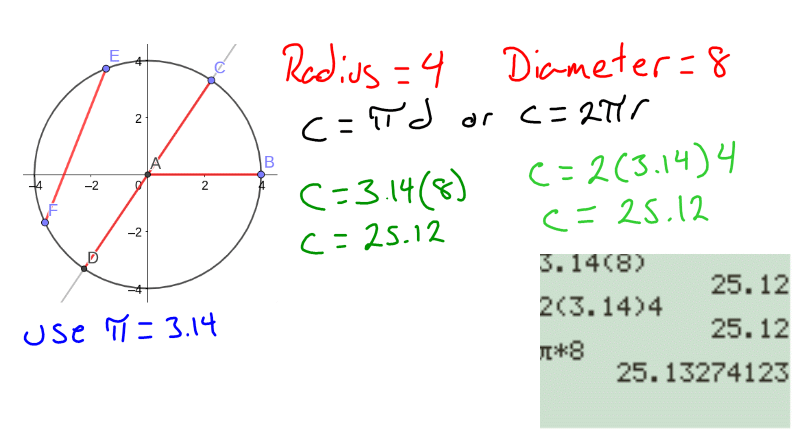 | |
|
Quick Question... Instructions:
To use the app:
|
| A.
Use Geogebra to create
A,
with radius AB = 3, diameter CD, and
chord BD |
|
| B. What is the diameter of the
circle in Practice Problem A? C. What is the circumference of the circle in Practice Problem A? D. What is the radius of a circle with a circumference of 62.8? |
|
| 1.
Use Geogebra to create
A,
with radius AB = 4, diameter CD, and
chord EF |
|
| 2.
Use Geogebra to create
G,
with radius GH, diameter HK = 6, and
chord LM |
|
| 3.
Use Geogebra to create
N,
with radius NO, diameter PQ = 7, and
chord QR |
|
| 4.
Use Geogebra to create
S,
with radius ST = 2.5, diameter UV, and
chord WX Make the chord parallel with the radius. |
|
| 5.
Use Geogebra to create
Z,
with radius AZ = 1.5, diameter BC, and
chord AB Make the radius perpendicular to the diameter. |
|
| 6. In #1, what is the diameter
CD = ? |
|
|
7. In #2, what is the radius GH = ? |
|
|
8 In #3, what is the radius NO = ? |
|
|
9. In #4, what is the diameter UV = ? |
|
| 10. In #5, what is the diameter
BC = ? |
|
| 11. In #1, what is the
circumference of
A
? |
|
| 12. In #2, what is the circumference
of
G
? |
|
| 13. In #3, what is the
circumference of
N
? |
|
| 14. In #4, what is the
circumference of
S? |
|
| 15. In #5, what is the
circumference of
Z
? |
|
| 16. If the circumference
of
Q
is 12, what is the radius of
Q
? Round your answer to the nearest hundredth. |
|
| 17. If the circumference
of
E
is 17, what is the diameter of
E
? Round your answer to the nearest hundredth. |
|
| 18. If the circumference
of
P
is 40.82, what is the radius of
P
? Round your answer to 2-decimal places. |
|
| 19. If the circumference
of
H
is 7.45, what is the diameter of
H
? Round your answer to 2-decimal places. |
|
| 20. In #5, what is the length of chord AB ? Round your answer to 2-decimal places and show all of your work! |
|

 to
begin, click
to
begin, click
 for full screen mode
 to
check your answer.
to
check your answer. to goto the next problem
  to stop the app