Tangent Line:
- A tangent line will
intersect ( touch ) the circle in
one place..
- A tangent line will
always be perpendicular to the radius with an end point at
the intersection of the line and circle
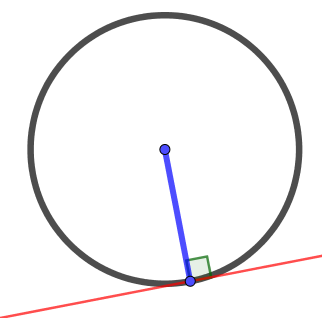
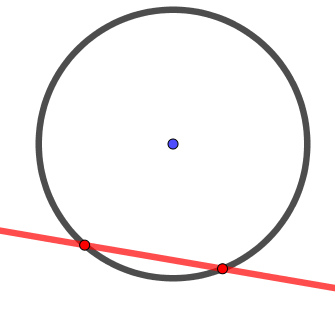
There are really only 2 different ways that a line can interact with a circle. It can either intersect ( touch ) it in one place, this is called a Tangent. The other possibility is for a line to intersect ( go through ) a circle in two places, this is called a Secant.
|
Tangent Line:
|
|
|
Secant Line:
|
 |
|
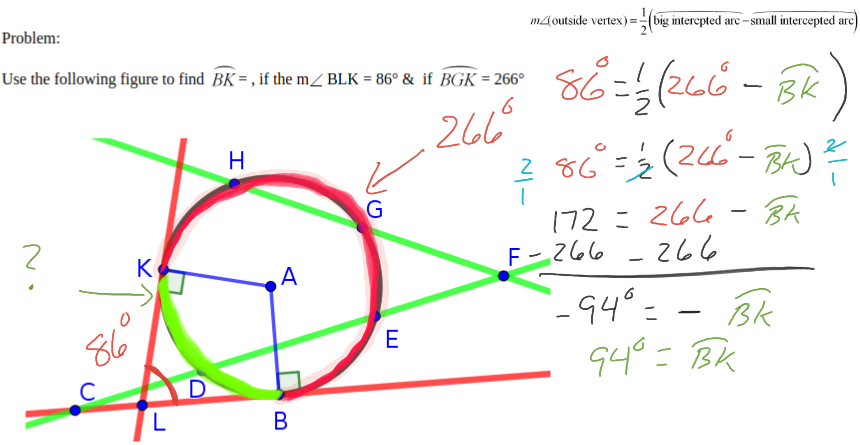
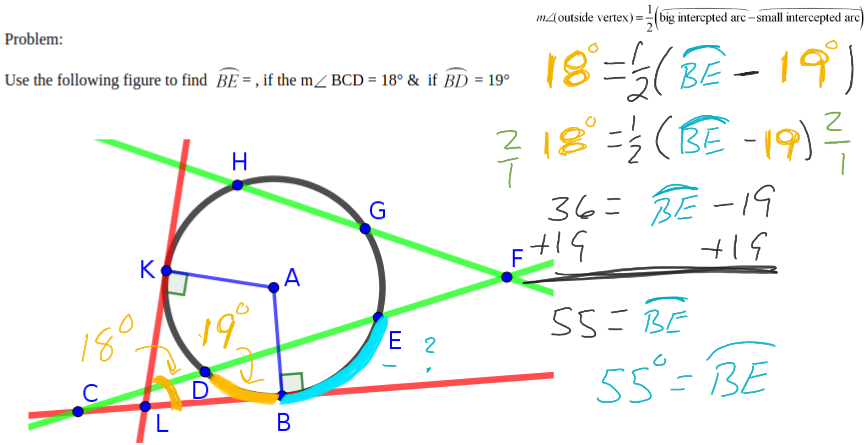
The measure of an angle whose vertex is outside of a circle is equal to half the difference of the intercepted arcs.
|
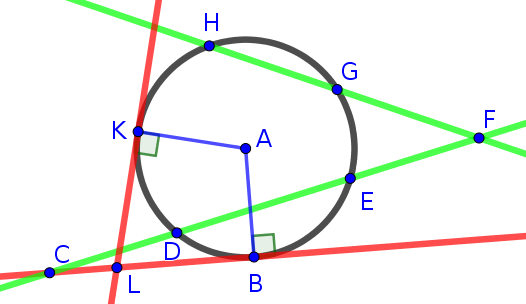 |
| Task: Use Geogebra to create  A,
with Tangent Line BC & Secant Line CD A,
with Tangent Line BC & Secant Line CD
|
Solution: Step: 1. Plot Point A & Point B 2. Create Circle: Center A through Point B 3. Create Tangent Line through Point B - Select the Tangents tool ( 4th tool icon ) - Click on Point B then click on the circle 4. Create Point C, anywhere on the Tangent Line. 5. Create Point D, anywhere on the circle 6. Create Line CD, this is a Secant Line 7. Create radius AB 8. Identify m  ABC ABCYou now have A,
with Tangent Line BC & Secant Line CD Press  or or to run the Geogebra build simulation.
Watch the video: |
|
Problem: Use the following figure to find
m |
Watch the video: |
Solution: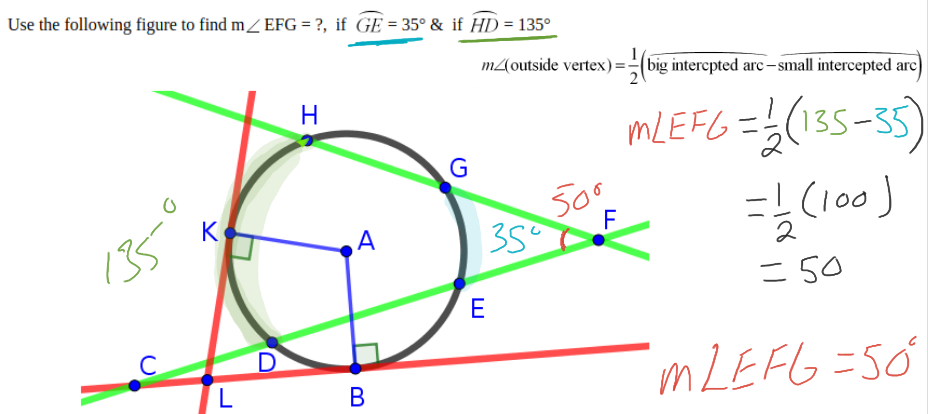 | |
|
Quick Question... Instructions:
To use the app:
|
Example C
|
|
Quick Question... Instructions:
To use the app:
|
Example D
|
|
Quick Question... Instructions:
To use the app:
|
| Use the figure on the right to answer the
following questions: If m BAG
= 103°,
 =
52°, =
52°,
 =
157°, =
157°,
 =
79° =
79°A What is the degree measure of  =
? =
?B. What is the degree measure of  =
? =
?C. What is the degree measure of m BKG =
?D. What is the degree measure of m BCE =
?E. What is the degree measure of m DFH=
? |
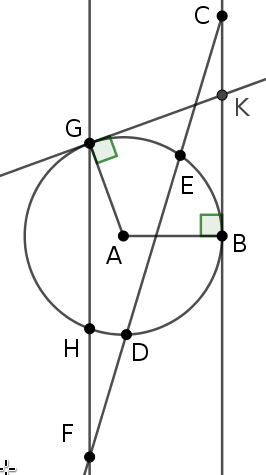 |
| Use the figure on the right to answer the
following questions: If m BAG
= 80°,
=
92°,
 =
207°, =
207°,
 =
179° =
179° |
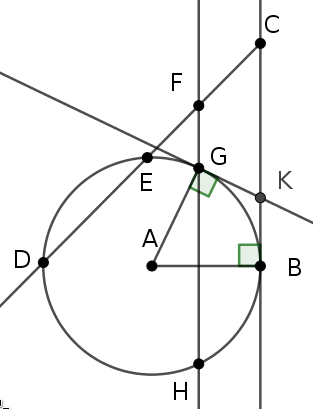 |
| 1. What is the degree measure of
=
? |
|
2. What is the degree measure of
 =
? =
? |
|
| 3. What is the degree measure of mBKG =
? |
|
| 4. What is the degree measure of
mBCE =
? |
|
| 5. What is the degree measure of
mDFH=
? |
|
|
Use the figure on the right to answer the
following questions: If m BCE
= 17°, =
176°,
=
88°,
=
160° =
176°,
=
88°,
=
160° |
|
| 6. What is the degree measure of
=
? |
|
| 7. What is the mBAG =
? |
|
| 8. What is the mBKG =
? |
|
| 9. What is the mHFD =
? |
|
|
Use the figure on the right to answer the following questions: If m BAE
= 85°, mGAE
= 22°, mGAH
= 78°,m HAK
= 76° , mKAD
= 53°, |
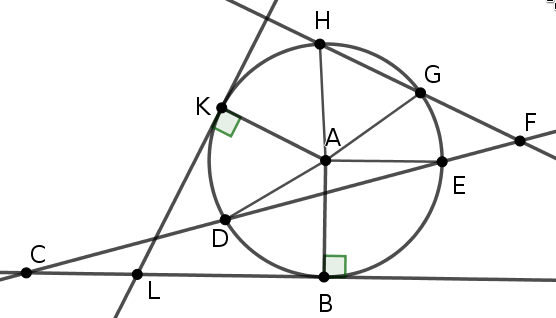 |
| 10. What is the mBAD =
? |
|
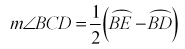
| 11. What is the mBCD =
? |
|
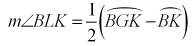
| 12. What is the mBLK =
? |
|
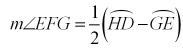
| 13. What is the mEFG =
? |
|
14. Use Geogebra to construct the following
A
with radius AB = 3.965 A
and segment AD.15. What quadrilateral do the points ABDC form?
16. If you move point C on the circle so that you have diameter CB,
what happens to point D & why do you believe that happens?

 to
begin, click
to
begin, click
 for full screen mode
 to
check your answer.
to
check your answer. to goto the next problem
  to stop the app
 =
, if the m
=
, if the m =
266°
=
266°