, on the graphing
calculator.
, on the graphing
calculator.Now that we can identify each part of the trigonometry ratios in a right triangle: How is knowing this information useful? and/or How can we use this information?
When we were identifying the trigonometry ratios in a right triangle we were only working with the sides not the acute angles in the right triangle. Once we have identified the trigonometry ratios in a right triangle we can use this information to find the measure of each acute angle. We can actually extend this idea so that we can find missing measures in any right triangle, given some information!
If we know...
... the measures of any two sides, we can find the unknown angles and side measures.
or
... the measure of only 1 acute angle and the length of any side, we can find the unknown angles and side measures.
Before we begin, we will need to identify a couple of things...
We need to identify a symbol that will be used throughout trigonometry and in many other areas of mathematics.
The Greek letter Theta, θ, is used to identify an unknown angle
measure. Which is why you see the symbol on the variable button,
, on the graphing
calculator.
We will be relying the graphing calculator, but we need to set it up before we can use it.
| 1. Reset the graphing calculator: Press:  then then
 then then
 then then
 then then
 The calculator should be reset and you should see something similar to this: 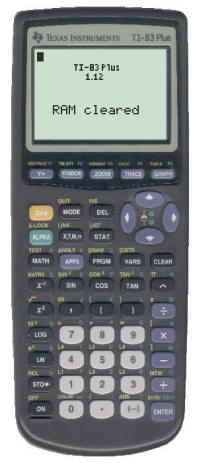 |
2. Change the mode into degrees. Press:  You should now see:  Next, we need to select "Degree" Press:  ( twice ) then ( twice ) then
 then then
 You should now see:  Note: you will need to do this every time you reset the calculator. It is also a VERY GOOD idea to check this before you begin. |
Note: All scientific calculators have this option, make sure that you know how to use your calculator!
| We need to re-write the ratio to help us out. Since we know that: |
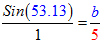
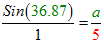
 |
|
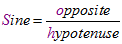 and
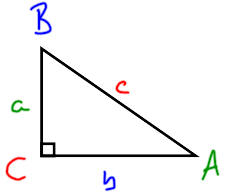
from Right Triangle ABC we get: and
from Right Triangle ABC we get:
 and
and
 |
||
| We will now use θ rather than the variable label of the angle/vertex. | ||
| For angle A: | For angle B: | |
|
or, better still...  |
or, better still...  |
|
|
Given Right Triangle ABC with side lengths of 3,4,5. Use Sin to find the measure of angle A: Solution: Step 1, Set up the ratio 
Step 2, Re-write as inverse sine  Step 3, Enter in to the Graphing Calculator Press: then
 and you will see and you will see Now you can enter the fraction Press:  then then
 then then
 then then
and you should now see  Step 4, The answer We were given a long decimal number as an answer, so we will round it to 2-decimal places. So the degree measure of angle A is about 36.87o. |
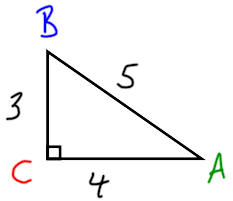 Note: When we need to find the degree measure of an angle, we use the inverse sine on the calculator. The sine function will give us the ratio of the side opposite to the hypotenuse. |
Watch the video: |
|
Instructions:
To use the app:
|
|
Given Right Triangle ABC with side lengths of 3,4,5. Use Sin to find the measure of angle B: Solution: Step 1, Set up the ratio  Step 2, Re-write as inverse sine  Step 3, Graphing Calculator Enter the information into the calculator and we get  Step 4, The answer So the degree measure of angle B is about 53.13o. |
Now you are probably ( hopefully ) wondering why I didn't just subtract the measure of angle A from 90o to find the missing angle measure. Well, when I do that, I get the same answer!  |
Watch the video: |
Now let us see what happens if I only know the degree measure of one acute angle and the length of any angle and the length of any one-side
|
To begin with, if we know only 1 of the acute angles we can
subtract it from 90o to
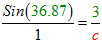
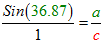
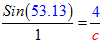
find the other acute angle. Solution: If we know A = 36.87o, then B = 90o - 36.87o = 53.13o or If we know B = 53.13o, then A = 90o - 53.13o = 36.87o So that seems fairly simple to do, now what about the sides? To find a missing leg & hypotenuse, we will need to set-up sine ratio for each missing side. Remember: Here we only know the side opposite angle A...
In order to find the missing sides I will need to find the hypotenuse first and then the other side. So, if we do not know the length of the hypotenuse, then it is the first measurement we need to find To solve for c we can solve the ratio by using this little trick: "Multiply the numbers on the diagonal, then divide by the other number". We enter it into the graphing calculator as follows:

then and 


You should now see:
We get the answer of 4.999988091, but since we are working with a triangle where we know what the side lengths should be we can let c = 5. Now that I know c = 5 I can re-write the sine ratio to find the missing side. so: 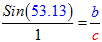 is now
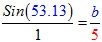 We enter it into the graphing calculator as follows:
then
and
You should now see:
We get the answer of 3.999994641, but since we are working with a triangle where we know what the side lengths should be we can let b = 4. So what would happen if we only knew the measure of the side opposite of angle B? Now if we only know the side opposite angle B.
|
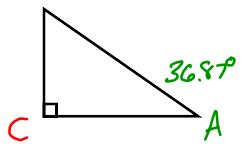 OR.. 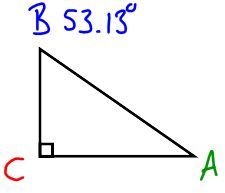 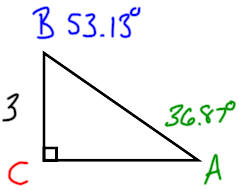 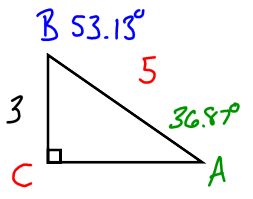 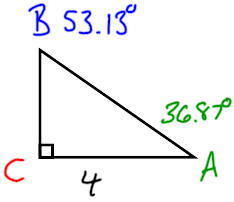 |
Watch the video: |
Now let us see what happens if I only know the degree measure of one acute angle and the length of the hypotenuse.
|
To begin with, if we know only 1 of the acute angles we can
subtract it from 90o to
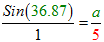
find the other acute angle. Solution: If we know A = 36.87o, then B = 90o - 36.87o = 53.13o or If we know B = 53.13o, then A = 90o - 53.13o = 36.87o So nothing really changes to solve for the missing angles. To find the missing legs, we will need to set-up sine ratio for each missing leg using the hypotenuse.
This time it does not matter which side we find first, since we are only missing one variable in each ratio.
Again we see that when using rounded numbers we will get answers that are close to the exact values that we know are the lengths of the sides of the right triangle. |
OR.. 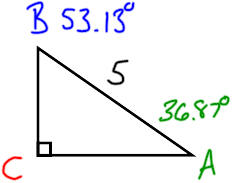 |
Watch the video: |
If we know the lengths of any 2-sides of a right triangle and neither of the acute angle measures, use the Pythagorean Theorem to find the 3rd side!
Given the Right Triangle:
A. 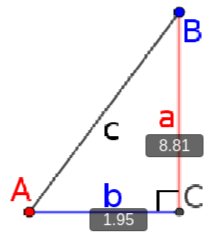
B. 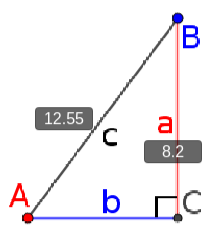
C. 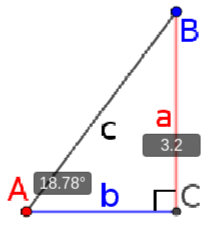
D. 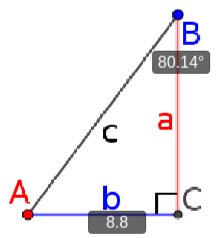
E. 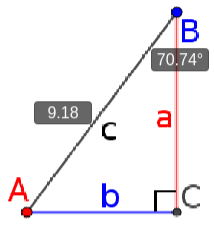
Use Sine to solve for the Missing Measures.
|
Instructions:
1-3 Do:
|
 for full screen mode
 to
check your answer.
to
check your answer. to goto the next problem
  to stop the app